
AI-native telephone research at scale.
Terapage AI-Moderated Telephone Interview
Terapage AI-Moderated Telephone Interview feature helps teams run structured, AI-assisted telephone interviews using programmable telephony, branded numbers, adaptive AI moderation, consent capture, recording, transcription, analysis and reporting from one connected research workflow.
Explore the Feature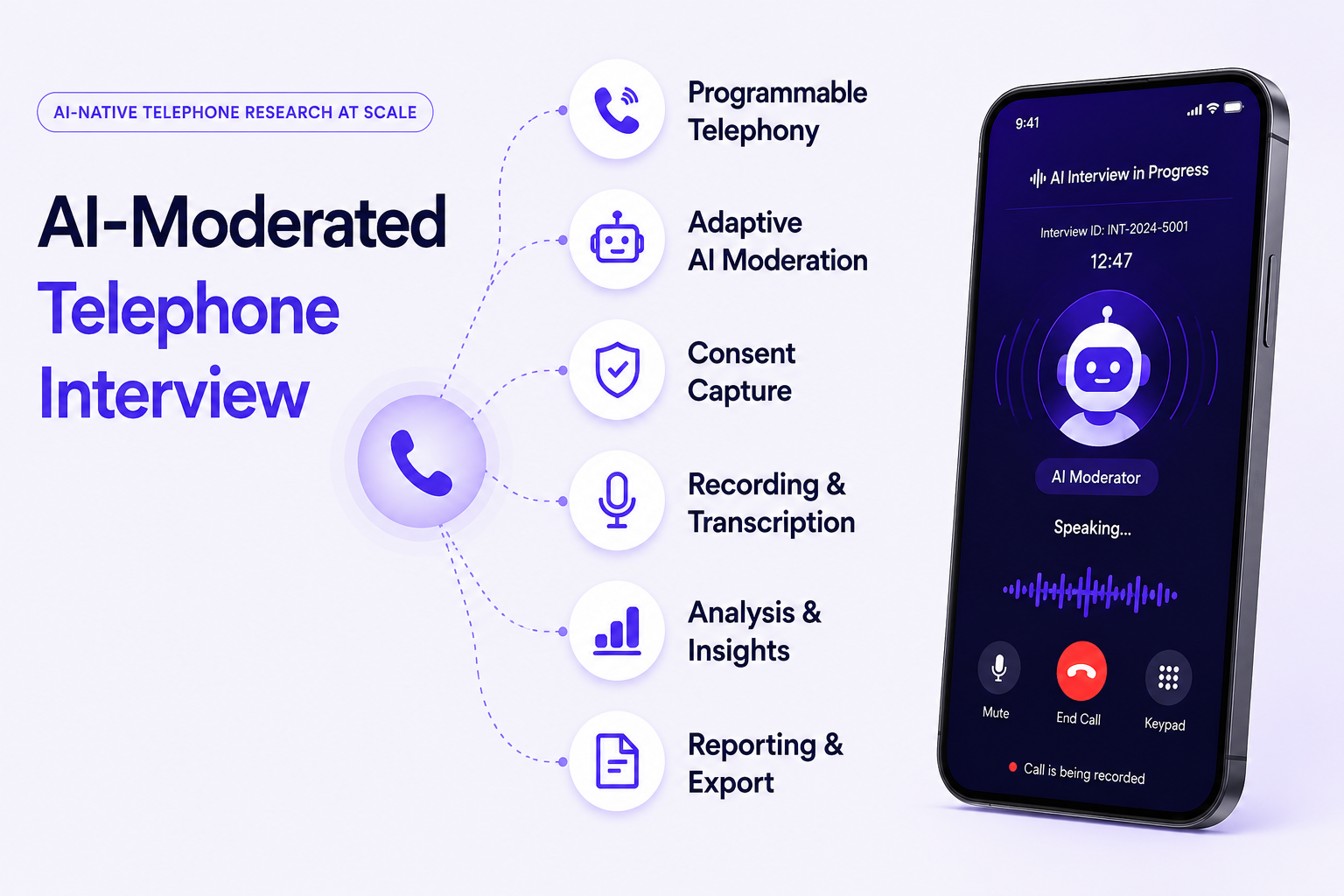
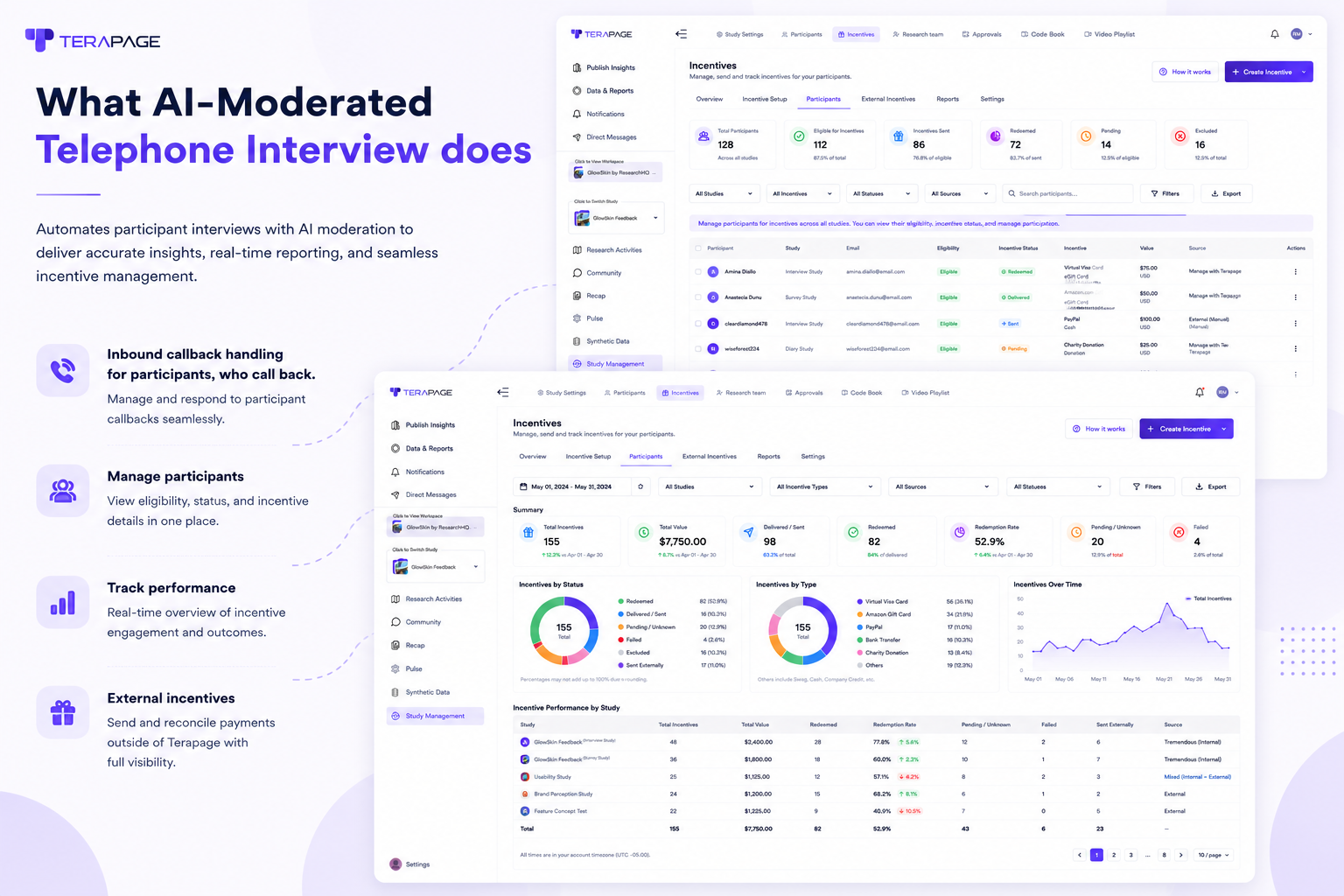
What AI-Moderated Telephone Interview does
It turns participant phone lists into managed research conversations. Researchers upload participants, select or buy numbers, configure the AI interviewer, define scripts and probing rules, set calling windows, launch the campaign, and review every transcript, recording, insight and cost from Terapage.
Outbound callsInbound callbacksAdaptive probingAI analysisBuild the campaign around the study, not around a call centre
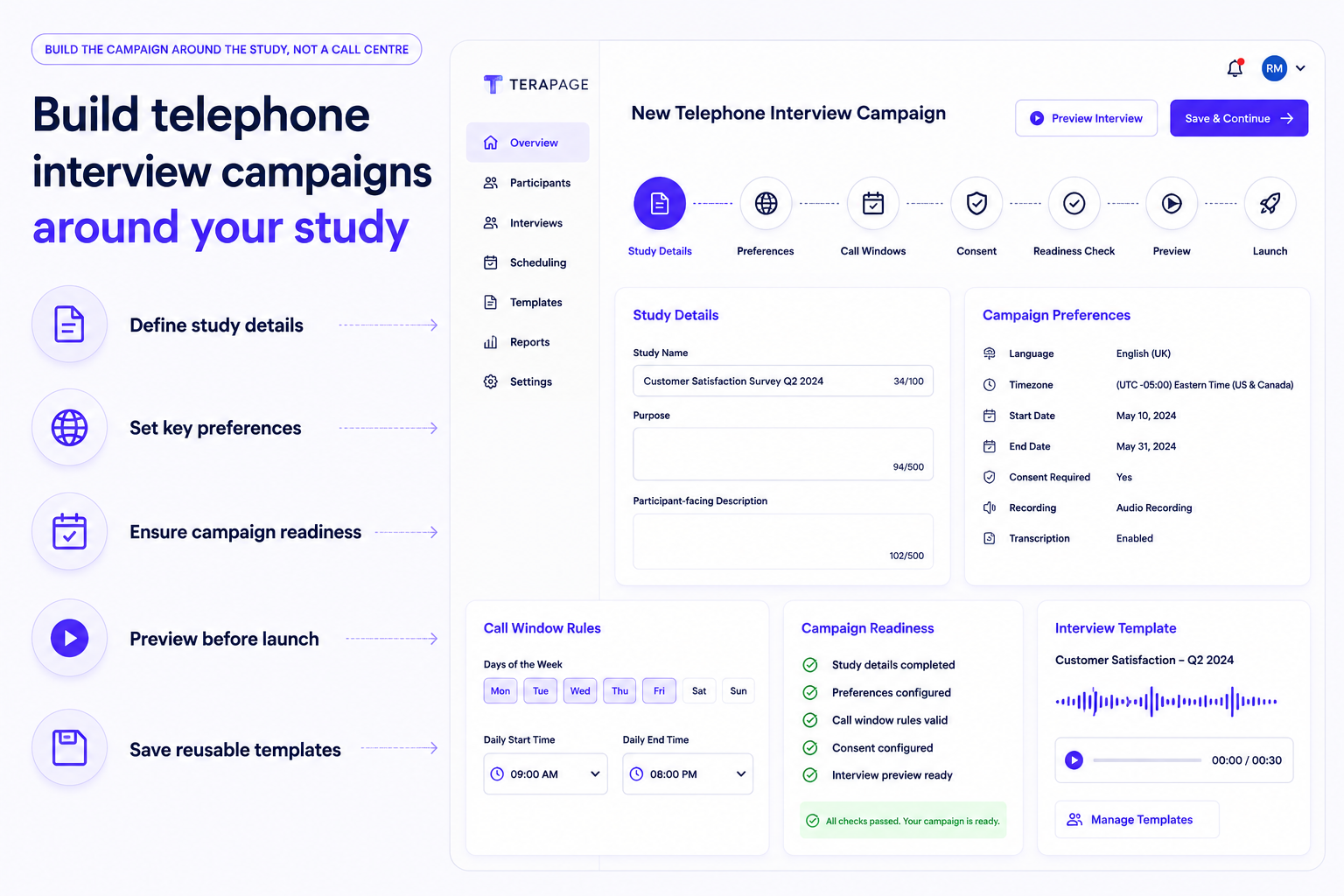
Create a telephone interview campaign from study details, project goals, language, timezone, consent requirements and call-window rules. This keeps the CATI workflow inside the wider Terapage study environment instead of splitting scripts, participants, interviews and analysis across separate tools.
- Define study name, purpose and participant-facing description.
- Set language, timezone, dates, call windows and campaign readiness checks.
- Preview the interview before launch and save reusable templates.
Upload, import and validate participants
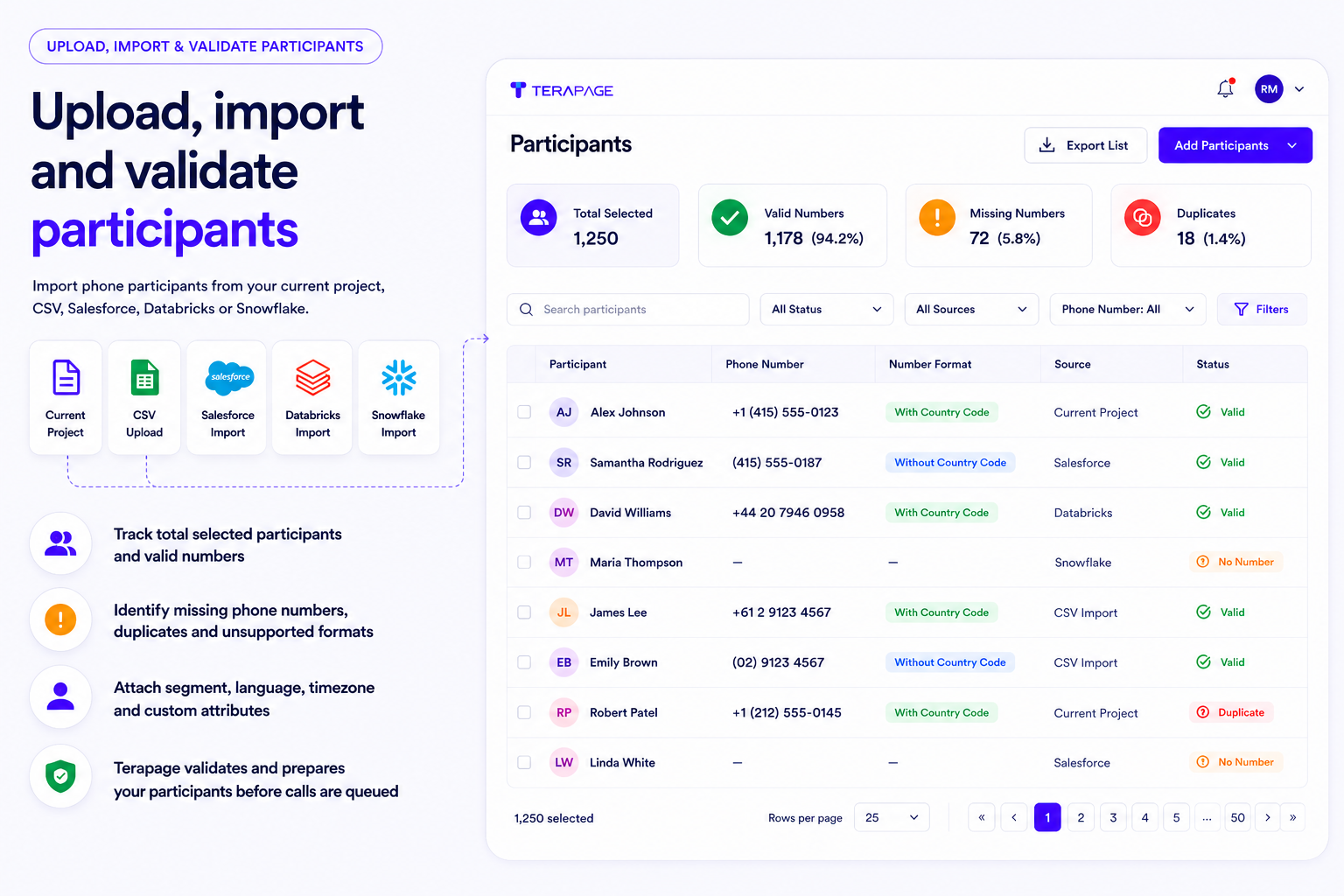
Import phone participants from a current project, CSV, Salesforce, Databricks or Snowflake. Terapage checks phone number quality, country code, duplicate records, missing numbers and source before calls are queued.
- Track total selected participants and valid numbers.
- Identify missing phone numbers, duplicates and unsupported formats.
- Attach segment, language, timezone and custom attributes to each participant.
Buy, assign and brand local phone numbers
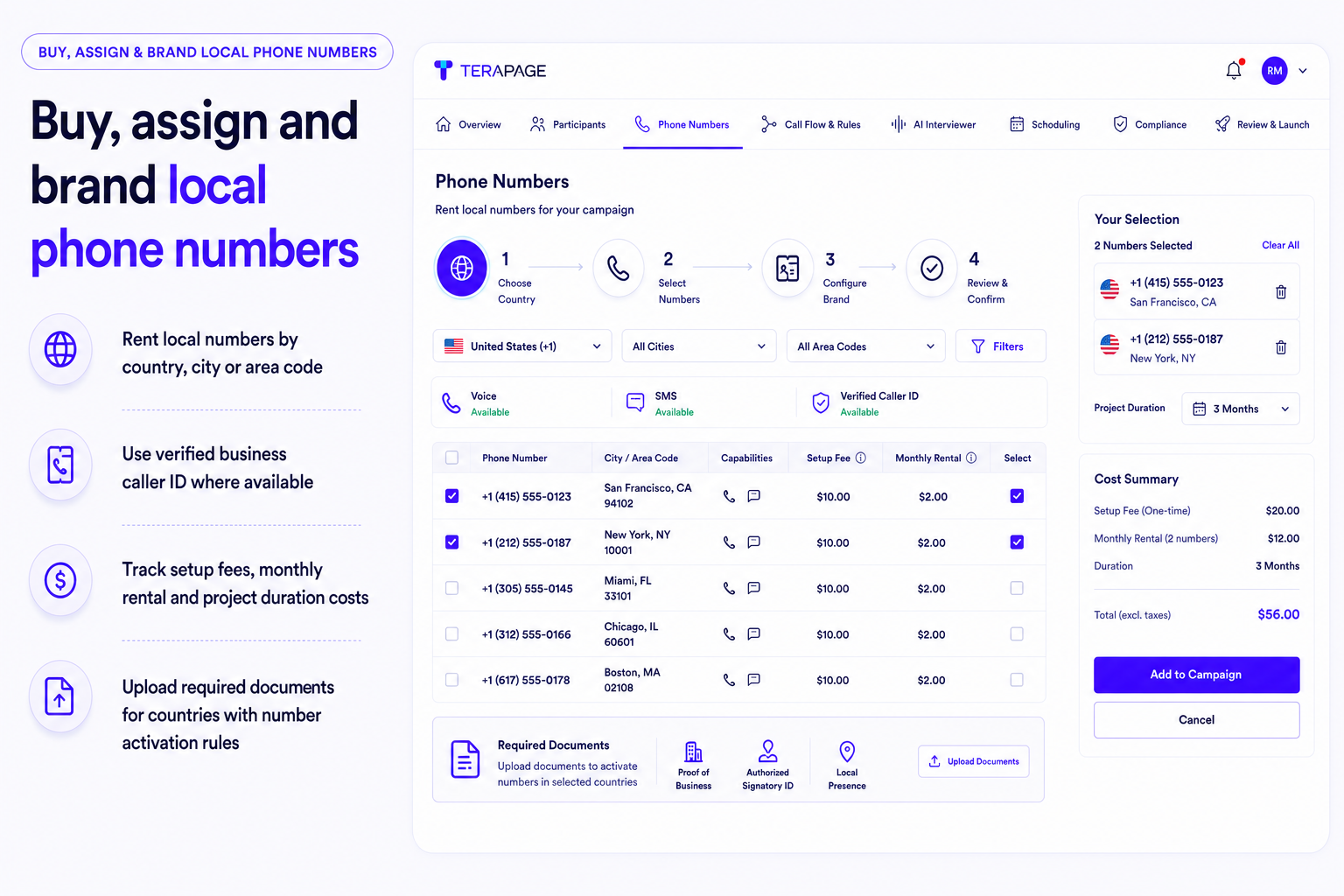
Provision numbers for specific markets, regions or campaigns. The number management screen supports local number search, country filters, voice/SMS capabilities, caller ID branding and project-level cost visibility.
- Rent local numbers by country, city or area code.
- Use verified business caller ID where available.
- Track setup fees, monthly rental and project duration costs.
- Upload required documents for countries with number activation rules.
Configure the AI interviewer’s voice, tone and consent message
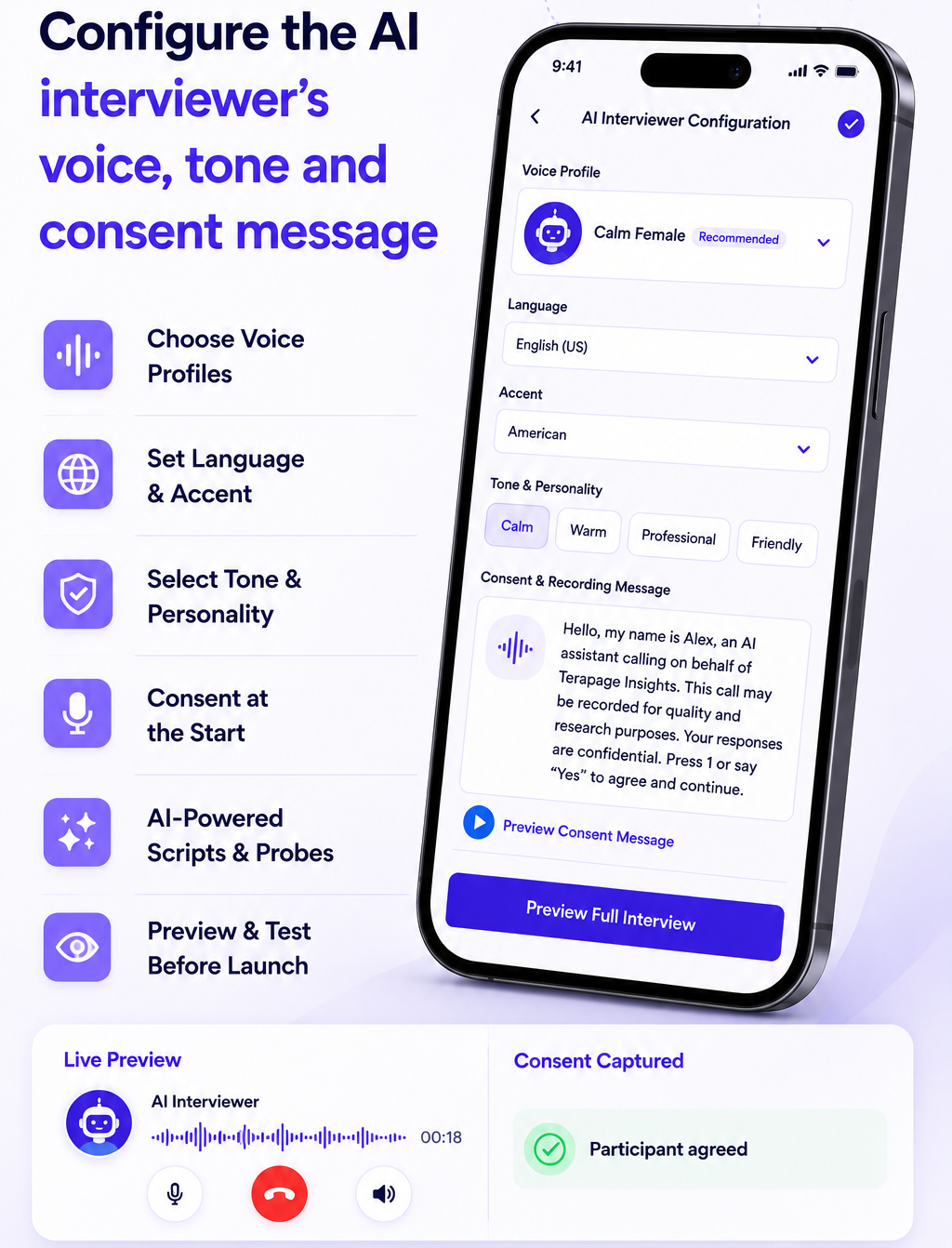
Researchers can choose the interviewer voice, language, accent, tone and personality. Consent and recording disclosures are placed at the start of the call so the AI can capture permission before the substantive interview begins.
- Choose voice profiles such as calm, warm, professional or brand-aligned.
- Set language and accent for different markets.
- Preview or clone a brand voice where permitted.
- Generate scripts and probes with AI while keeping researcher control.
Create questions, probes, branching logic and variables
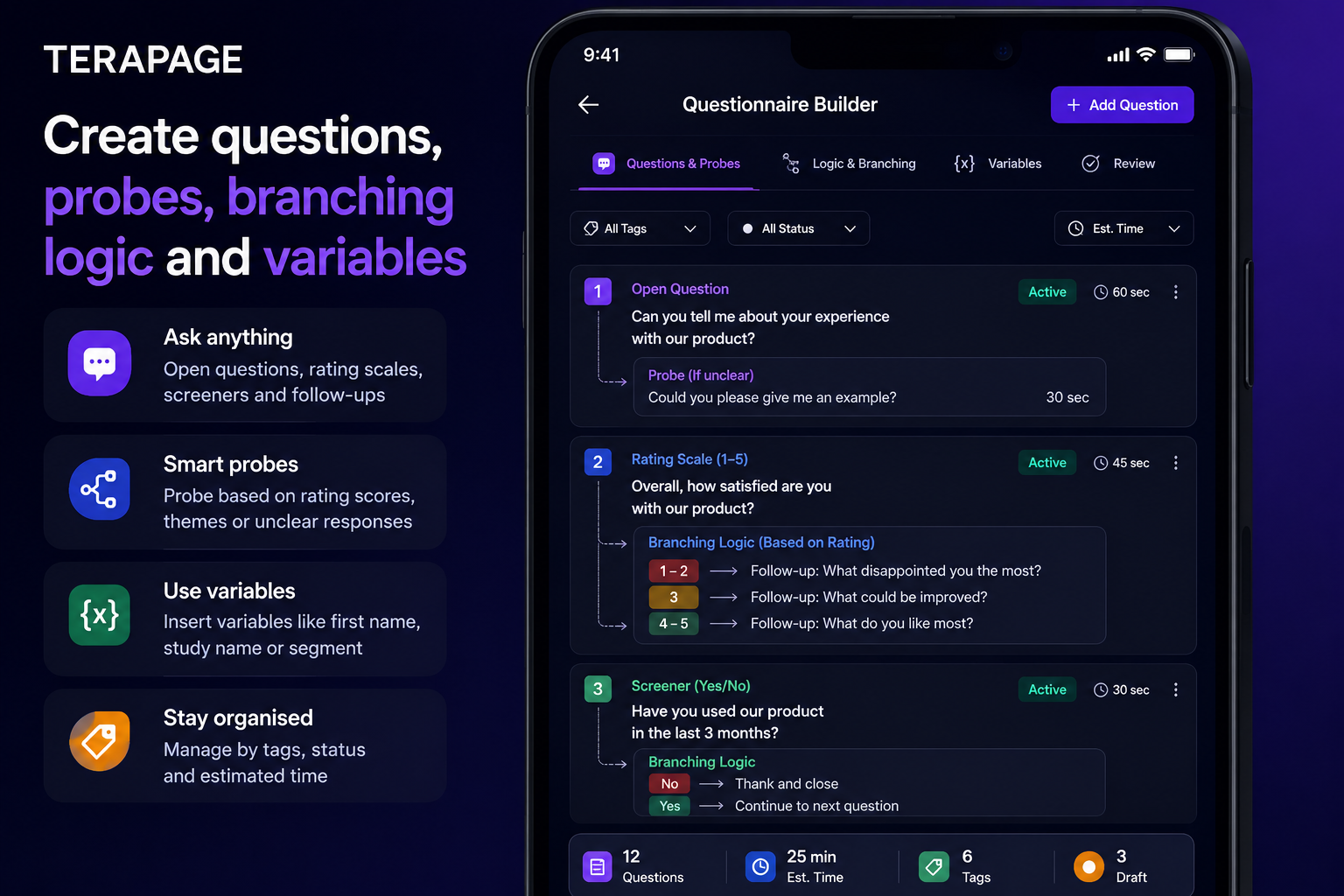
The AI interviewer is not limited to a static questionnaire. Researchers can create question types, follow-up probes, logic triggers, tags and answer-time expectations so the call feels like a guided interview instead of a robotic survey.
- Open questions, rating scales, screeners and follow-ups.
- Probe based on rating scores, key themes or unclear responses.
- Use variables such as first name, study name or segment.
- Organise questions by tags, status and estimated time.
Manage the full interview script before launch
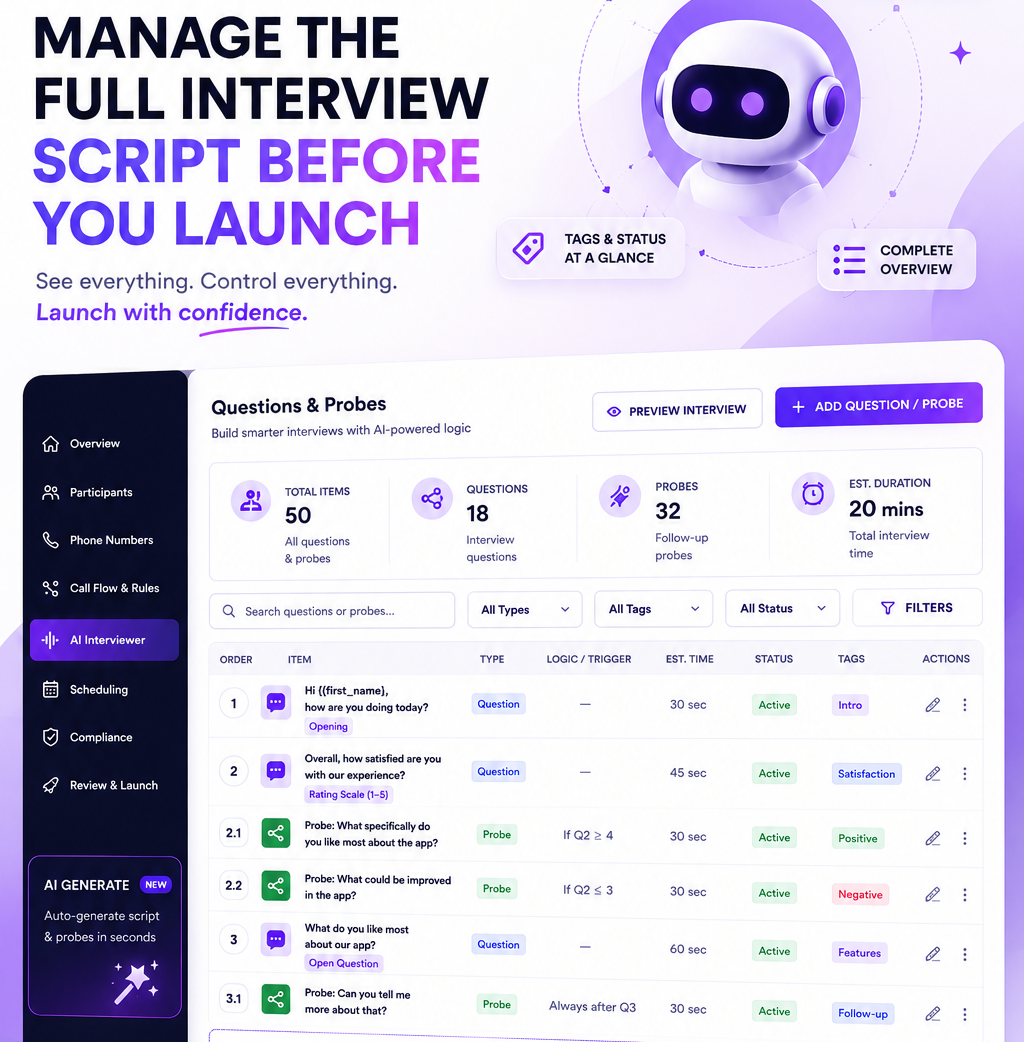
The Questions & Probes screen gives researchers a clear view of the whole interview: order, item type, trigger logic, estimated time, status, tags and actions. This makes telephone interviewing scalable while keeping the method auditable.
Integrated with research project management and reporting tools, this structure ensures interview designs stay consistent across studies while remaining easy to update, audit, and optimise over time.
Researchers can also connect interview scripts with participant management workflows, ensuring routing logic, eligibility rules, and completion status remain fully aligned throughout the data collection process.
Control call flow, retries, silence handling and no-match outcomes
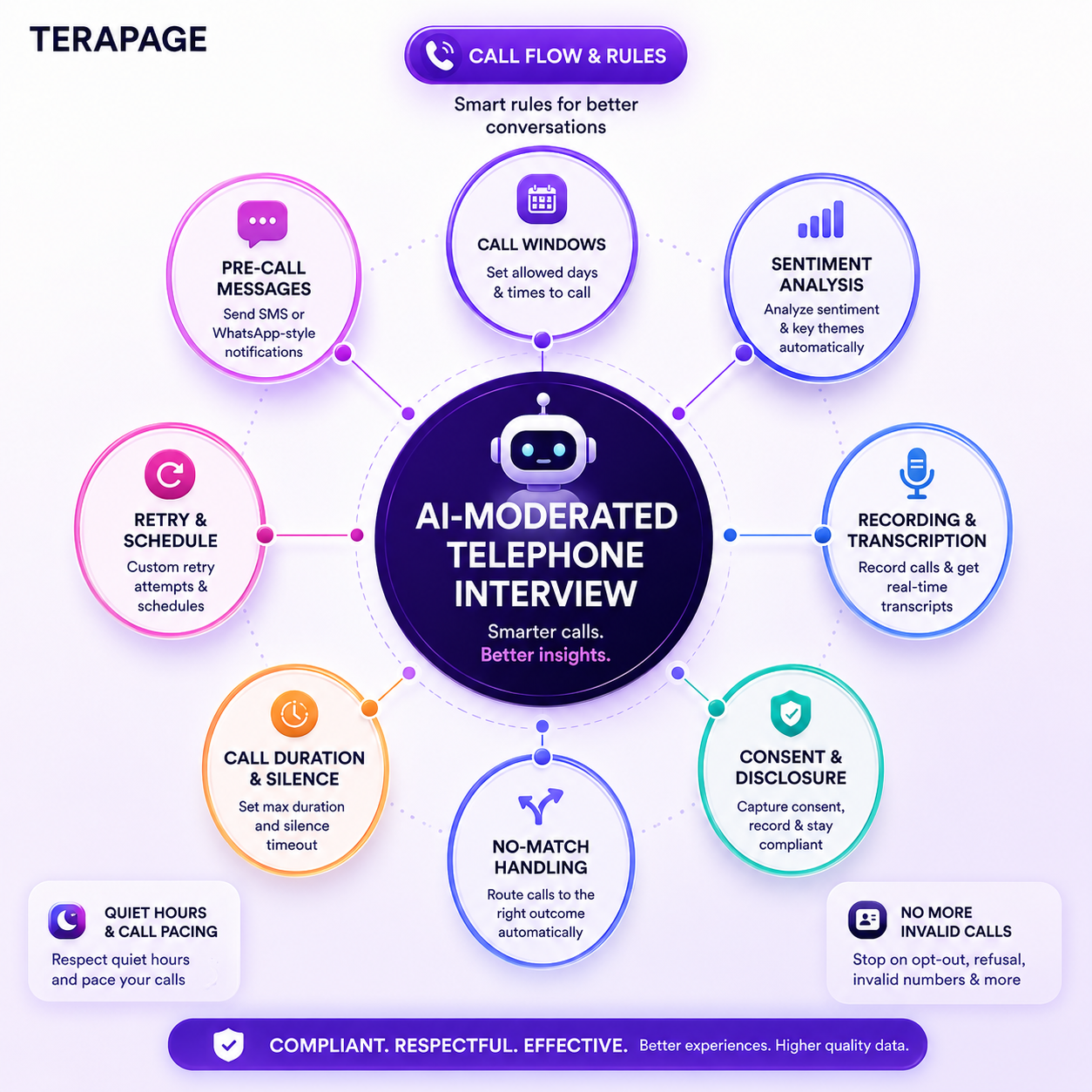
Configure pre-call messages, call windows, retry attempts, maximum duration, recording, transcription, sentiment analysis and no-match handling. The rules engine helps campaigns avoid spam-like behaviour and keeps calling inside approved windows.
- Send SMS or WhatsApp-style pre-call notifications.
- Stop retrying after opt-out, invalid number, refusal or completion.
- Route rejected, busy or invalid calls to the correct status.
- Use quiet hours, call pacing and custom retry schedules.
Inbound callback handling for participants who call back
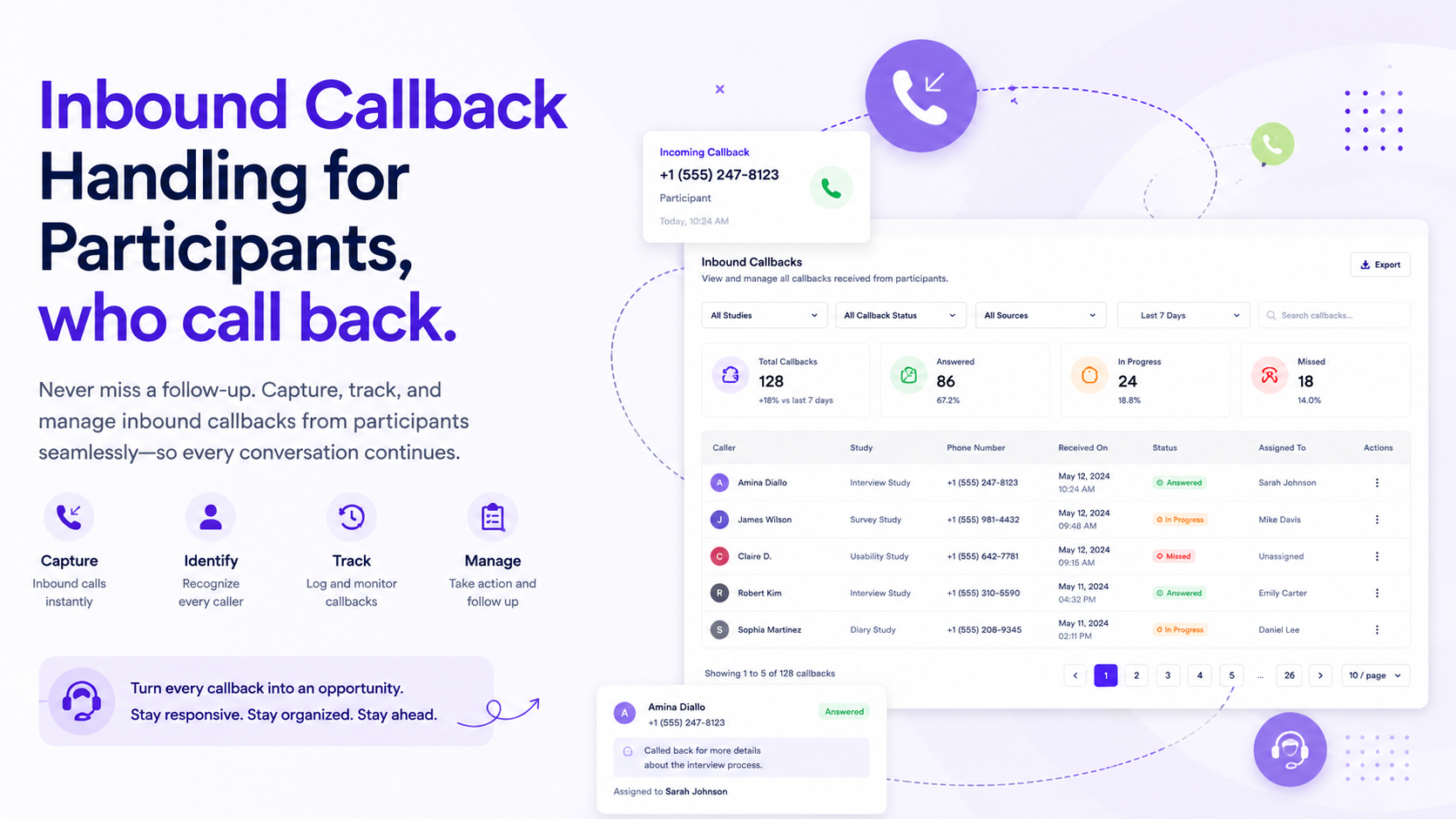
When a participant calls a campaign number, Terapage can greet the caller, check the inbound number against workspace, project and campaign participant records, confirm the participant identity, explain the call purpose and continue the interview. If no match is found, the caller can leave a message with name, reason and callback details for researcher follow-up.
Scheduling that respects participant timezones
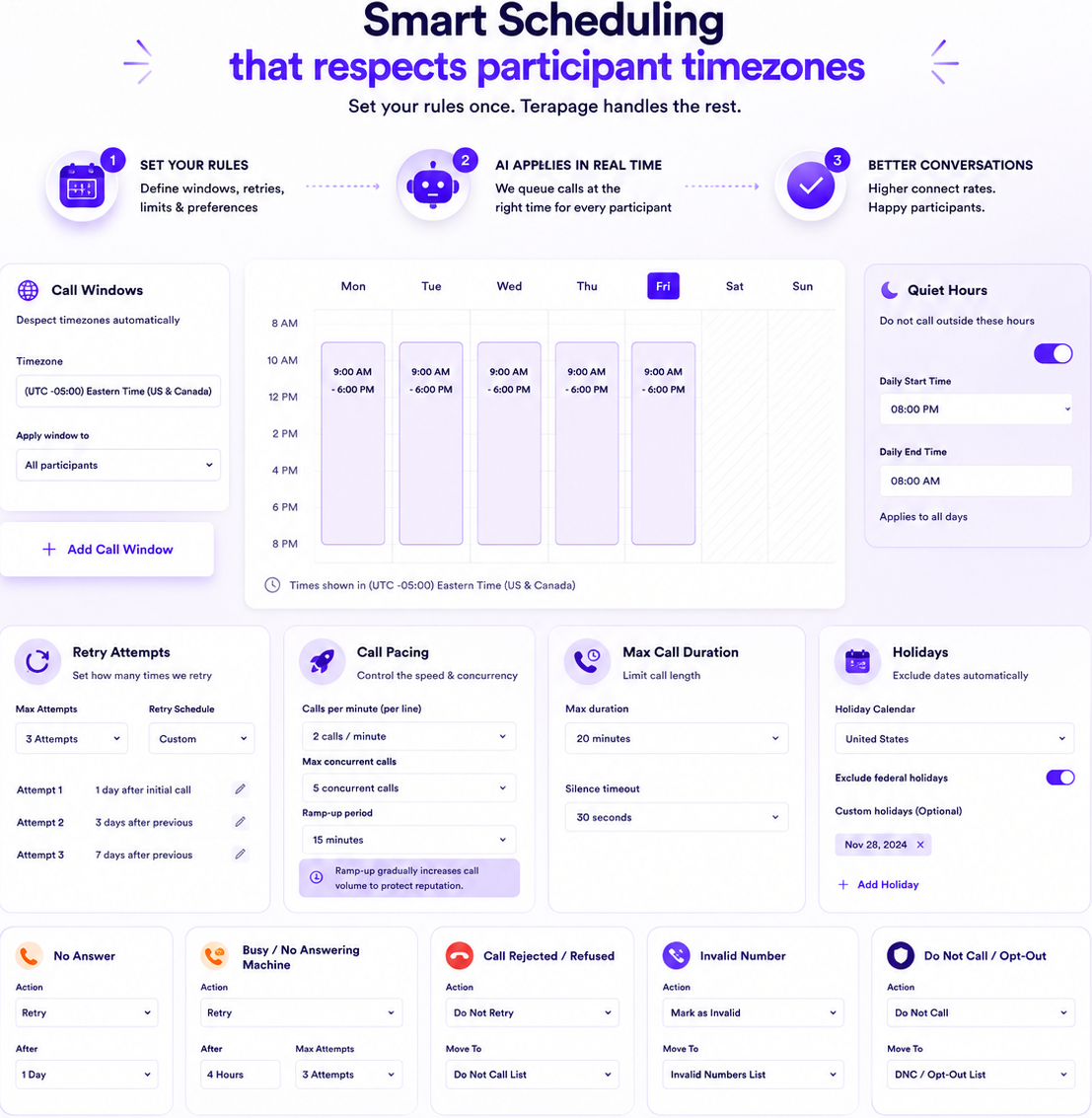
Define calling days, start and end times, retry spacing, maximum attempts, concurrent call limits, ramp-up period, quiet hours and holiday exclusions. Terapage applies these rules in real time when queuing calls.
Scheduling rules are enforced in real time using research workflow controls, ensuring every call respects participant time zones, availability windows, and operational constraints across studies.
This helps optimise contact rates while maintaining a better participant experience through intelligent scheduling logic, integrated participant management, and scalable research operations.
Compliance, consent, DNC and audit logs built in
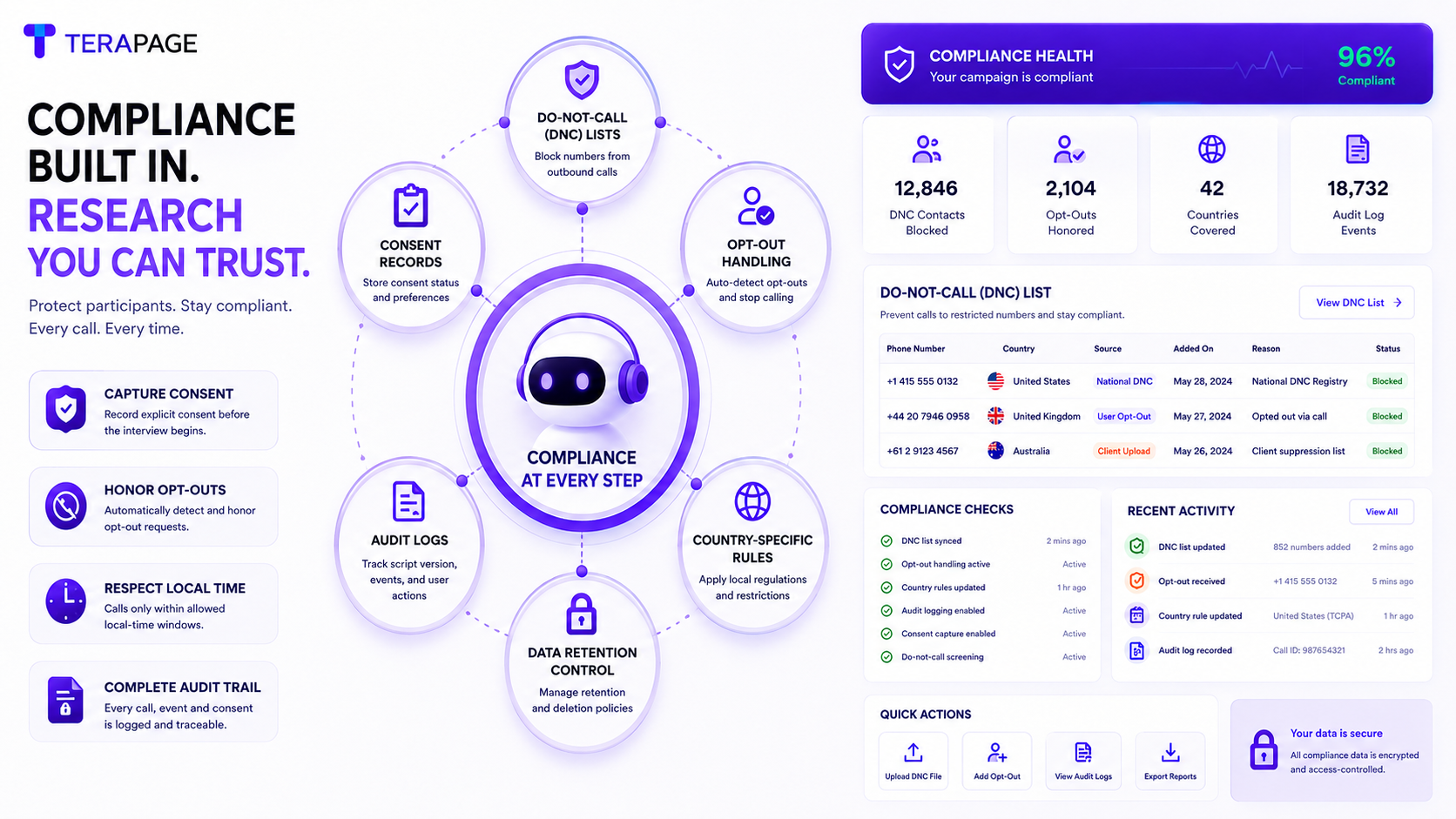
Telephone research must be controlled carefully. Terapage supports do-not-call lists, opt-out handling, country-specific rules, consent records, audit logs, compliance health checks and data retention settings.
- Capture consent before the interview begins.
- Honour opt-out requests such as “stop”, “remove me” or “don’t call me again”.
- Prevent calls outside allowed local-time windows.
- Store script version, call events, consent status and recording disclosure.
Review readiness, budget and launch with confidence
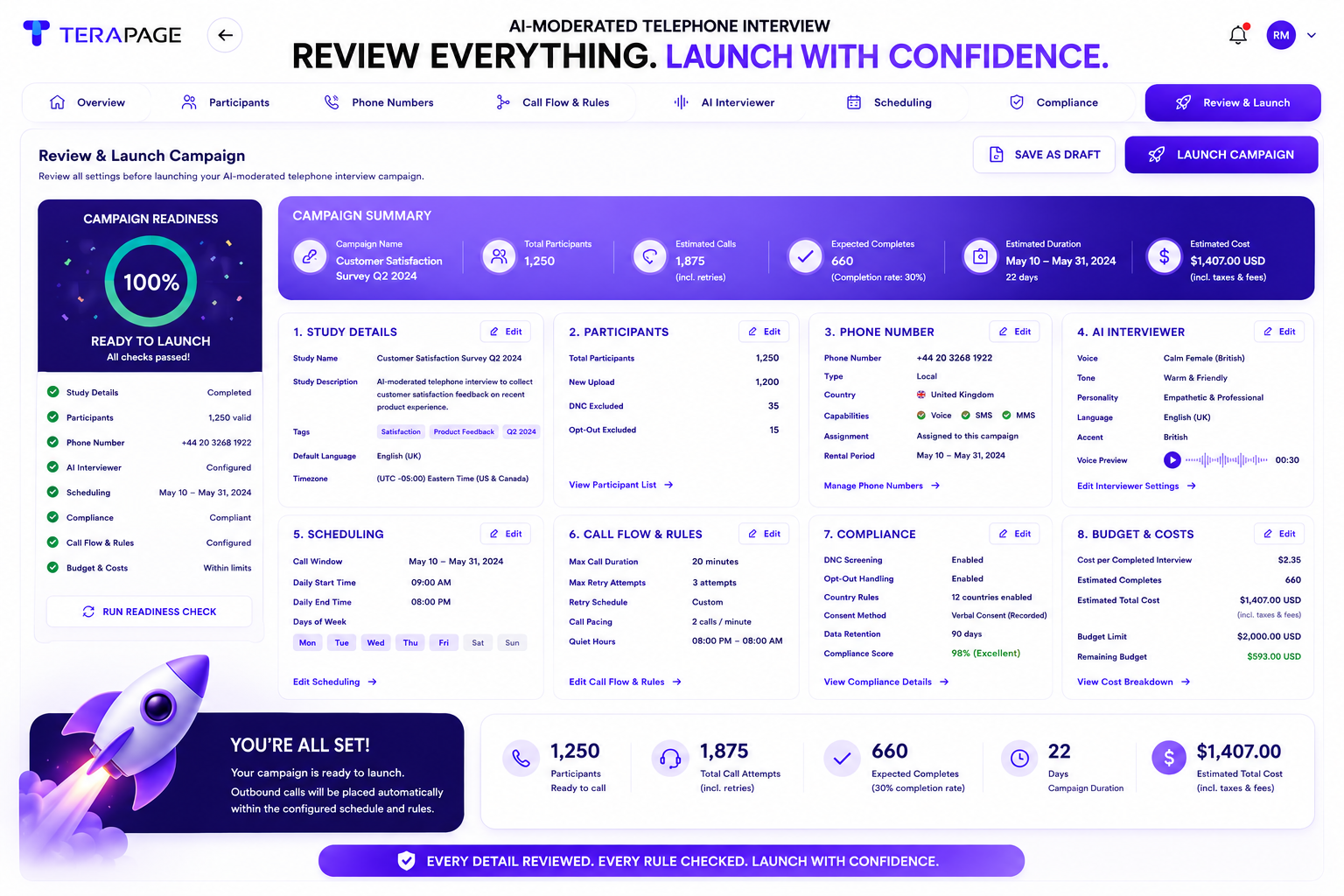
Before launch, the researcher sees every major configuration: study details, participants, phone number, AI interviewer, scheduling, call flow, compliance and budget. Campaign readiness checks reduce mistakes before calls begin.
- Review expected completes, call attempts, duration and cost.
- Confirm DNC exclusions and opt-outs before launch.
- Save draft or launch the campaign when checks pass.
Frequently Asked Questions
Upload your participants, choose your interviewer voice, set the call rules, and let Terapage conduct, transcribe, analyse and report telephone interviews at scale.
Terapage AI-Moderated Telephone Interviewing, also known as Terapage Voice Research or AI CATI, allows research teams to conduct telephone interviews at scale using AI-assisted voice moderation. Researchers can upload participant lists, configure the AI interviewer, define the interview script, set call rules, schedule outbound calls, capture consent, record interviews, transcribe conversations and generate insights from completed calls. It is designed to support modern telephone research without relying entirely on manual call-centre operations.
It serves a similar research purpose, but it is more automated and AI-assisted. Traditional CATI usually relies on human interviewers calling participants and manually following a script. Terapage’s AI-moderated telephone interview feature allows the AI interviewer to place calls, introduce the study, capture consent, ask questions, probe responses, manage call flow and produce transcripts and analysis. Human researchers can still remain in control of campaign setup, scripts, compliance rules, review, reporting and, where enabled, live handover.
No. The feature is designed to assist research teams, not replace them. Researchers still design the study, define objectives, upload or manage participants, create interview scripts, configure consent, set call rules, review outputs and interpret findings. The AI helps with scalable interview execution, transcription, structured probing, call handling and analysis support.
A researcher creates a telephone interview campaign, uploads participants, selects or provisions a phone number, configures the AI interviewer, adds the interview script, sets consent wording, defines call windows and retry rules, then launches the campaign. Terapage queues the calls, places outbound calls through the connected telephony provider, captures consent, conducts the AI-moderated interview, records and transcribes the call where enabled, and then generates summaries, themes, sentiment and other research outputs.
Yes. Researchers can select or buy supported phone numbers for telephone interview campaigns. The system can support number search by country, region, city or area code, number assignment to a campaign, caller ID branding where available, and number release after the campaign ends. Some countries may require additional verification, address details or business documentation before numbers can be activated.
Yes, number porting can be supported for enterprise or eligible clients. Porting usually requires documentation such as a letter of authorisation, a recent phone bill and business verification documents where applicable. Porting is not instant and depends on carrier approval, local requirements and number portability rules in the relevant country.
Yes. Researchers can upload participant lists using formats such as CSV or Excel. Typical fields may include first name, last name, phone number, country, timezone, preferred language, segment, consent status, custom attributes, external ID and notes. The system should validate phone number format, country code, duplicate records, missing required fields, invalid numbers, unsupported countries and do-not-call matches before launch.
Yes. The participant upload process can check for missing numbers, duplicate phone numbers, invalid formats, unsupported countries and do-not-call conflicts. This helps reduce wasted call attempts, unnecessary costs and poor campaign performance.
Yes. Researchers can enable a pre-call message by SMS, WhatsApp or email depending on configured channels. This can inform participants that they may receive a research call, explain the purpose of the call and provide opt-out instructions. Pre-call messages can help improve answer rates, reduce confusion and support better consent transparency.
Yes. Researchers can configure the AI interviewer’s voice, language, accent, tone and personality. For example, the interviewer may be set to sound warm and professional, calm and clinical, neutral and academic, friendly and conversational, or more formal for compliance-sensitive studies. This allows the interview experience to match the study type, audience and brand tone.
The feature is designed to support multiple languages and accents depending on the available AI voice stack. Examples may include British English, American English, Indian English, Nigerian English, French, Spanish, Arabic and other supported languages. Language availability may vary depending on voice provider capability, transcription quality and campaign requirements.
Yes. Researchers can build telephone interview scripts with an introduction, consent statement, screening questions, main questions, probing instructions, skip logic, termination logic, thank-you message, incentive message, opt-out instructions and human handover triggers. The AI can use the script to conduct a structured interview while still probing naturally where appropriate.
Yes. The AI can use adaptive probing rules to ask relevant follow-up questions based on participant responses. For example, it can ask for clarification, request an example, probe the reason behind an answer, or explore a topic in more detail. This helps make the interview feel more natural than a rigid telephone survey.
Yes, where barge-in support is enabled. If a participant starts speaking while the AI is talking, the system should detect the interruption, stop the AI voice playback and listen to the participant before continuing with a context-aware response. This is important for making telephone interviews feel more natural and less robotic.
Before the substantive interview begins, the AI can read a consent statement and ask the participant to confirm whether they agree to continue. Participants may be able to give consent verbally or by pressing a keypad option, depending on the configuration. If consent is not given, the call should end politely, the status should be recorded as no consent, and the interview should not proceed.
Yes, calls can be recorded where enabled and legally appropriate. If recording is switched on, the participant should be informed before the substantive interview begins. Recording settings should be controlled by the researcher or account administrator and supported by audit logs. Recording laws may vary by country, so researchers are responsible for ensuring lawful consent and compliance.
Yes. Participants can opt out during the call by saying phrases such as “stop,” “remove me,” “do not call me again” or “opt out.” The system will stop the interview, add the participant to a do-not-call list, prevent future calls and log the opt-out event.
Yes. Do-not-call lists can be maintained at workspace, campaign, account or phone-number level. Before calls are placed, the system checks uploaded participants against relevant DNC lists to avoid contacting restricted numbers.
Yes. Researchers can configure call windows by date, time, timezone and day of week. They can also define quiet hours, retry delays, maximum call attempts, no-call days and concurrency limits. This ensures participants are contacted at appropriate times and improves response rates.
Retry rules can be configured by the researcher or administrator. A typical setup may allow up to three attempts with delays between retries. The system stops retrying after completion, opt-out, refusal, invalid number or final call status.
If a participant does not answer the call, the system marks the attempt as “no answer”. Based on campaign rules, the system may retry the participant after a defined delay. Researchers can configure how many retries are allowed and the time gap between attempts to optimize reach and reduce unnecessary call volume.
If the system detects voicemail, it avoids starting the full interview. Depending on campaign configuration, it may either leave a short pre-recorded message or simply mark the attempt as voicemail and schedule a retry. This helps preserve interview quality and avoids collecting incomplete responses.
Yes. Inbound callback handling is supported. When a participant calls back, the system can identify the campaign via the assigned number and match the caller to a participant record if available. It may resume the interview, offer rescheduling, capture opt-out requests, or route the call based on campaign rules.
If the caller is not matched to any participant record, the system follows predefined handling rules. This may include playing an informational message, capturing voicemail-style responses, logging the call for review, or routing it to a fallback flow depending on campaign configuration.
Yes. Human handover is supported where enabled. A researcher can join a live call if the participant requests human assistance, if the AI confidence is low, if escalation rules are triggered, or if manual intervention is required. The call remains recorded and logged for audit and research integrity.
After each completed call, the system can generate transcripts, summaries, key themes, sentiment analysis, emotional indicators, key quotes, pain points, user needs, objections and structured research insights. These outputs help researchers quickly move from raw conversations to actionable findings.
Yes. Researchers can access call recordings, transcripts, summaries and analysis outputs through the campaign dashboard. Access is controlled by permissions, and data retention policies may apply depending on workspace configuration.
Campaign dashboards can display key performance indicators such as total participants, queued calls, completed calls, answered calls, no answers, failures, opt-outs, consent declines, completion rate, answer rate, average call duration, retry success rate and estimated cost metrics. These insights help researchers monitor performance in real time.
Yes. The system tracks costs including phone number rental, call duration, recording usage, transcription processing, AI analysis and human handover time where applicable. Both estimated and actual costs can be reviewed at campaign level.
Yes. Researchers can set budget caps and usage limits to prevent overspending. This is especially useful for large-scale campaigns with high retry volumes or multiple concurrent calls. When limits are reached, the system can pause or restrict further calling activity.
Terapage uses multiple safeguards to protect number reputation, including controlled call pacing, retry limits, number rotation, number pools, opt-out handling, and monitoring of call behaviour patterns. Where available, branded calling and verified caller identity systems may also be used.
Yes, where supported by the telecom provider and region. Caller ID branding may allow participants to see a verified business name or organisation identity instead of an unknown number. Availability depends on country regulations, carrier support and number type.
Yes. The system is designed for scalable telephone interviewing. It supports concurrent call limits, queue management, number pools, scheduling rules and performance controls to manage high-volume research campaigns efficiently.
The system uses programmable telephony for outbound and inbound calling, real-time audio streaming, speech-to-text transcription, AI voice generation, an interview orchestration engine, secure storage systems and analytics infrastructure to process and analyse interview data.
The supported coverage list includes Albania, Angola, Argentina, Barbados, Belize, Bermuda, Bolivia, Bosnia and Herzegovina, Colombia, Dominican Republic, Finland, French Guiana, Guadeloupe, Iceland, Israel, Jordan, Lebanon, Lithuania, Martinique, Mauritius, Mayotte, Mexico, Moldova, Monaco, Morocco, North Macedonia, Panama, Paraguay, Réunion Island, Saint Barthélemy, Saint Martin, Serbia, Slovenia, Ukraine, Zimbabwe, United Kingdom, United States, US Virgin Islands, Canada, Puerto Rico, Denmark, New Zealand, Costa Rica, Chile and Cyprus.
Countries currently supporting all number types include Angola, United States, US Virgin Islands, Canada and Puerto Rico depending on availability and carrier rules.
Local numbers are available in countries including Albania, Argentina, Barbados, Belize, Bermuda, Bolivia, Colombia, Dominican Republic, Finland, French Guiana, Guadeloupe, Iceland, Israel, Jordan, Lebanon, Lithuania, Martinique, Mauritius, Mayotte, Mexico, Moldova, Monaco, Morocco, North Macedonia, Panama, Paraguay, Réunion Island, Saint Barthélemy, Saint Martin, Serbia, Zimbabwe, United Kingdom, New Zealand, Costa Rica, Chile and Cyprus.
National numbers are available in Argentina, Barbados, Belize, Bermuda, Bolivia, Bosnia and Herzegovina, Colombia, Dominican Republic, French Guiana, Guadeloupe, Iceland, Israel, Jordan, Lebanon, Martinique, Mauritius, Mayotte, Moldova, Monaco, Morocco, North Macedonia, Panama, Paraguay, Réunion Island, Saint Barthélemy, Saint Martin, Serbia, United Kingdom, Costa Rica and Cyprus.
Mobile numbers are currently supported in Colombia, Ukraine, United Kingdom and Denmark. Some countries offering “all types” may also support mobile numbers depending on availability.
Toll-free numbers are supported in Albania, Argentina, Bermuda, Bosnia and Herzegovina, Colombia, Iceland, Mexico, Moldova, Monaco, Morocco, North Macedonia, Réunion Island, Saint Barthélemy, Saint Martin, Serbia, Slovenia, Ukraine, Denmark, New Zealand, Chile and Cyprus.
No. Finland currently supports local numbers only and does not support mobile number provisioning.
Slovenia currently supports toll-free numbers only.
Zimbabwe currently supports local numbers only.
Yes. Number availability can change depending on carrier inventory, regulatory requirements, country rules, address verification needs and telecom provider updates. Live availability should always be confirmed during provisioning.
No. Some countries allow instant provisioning, while others require manual approval, documentation, or address verification. Availability also depends on number type and carrier inventory.
Yes. Some countries require business registration documents, proof of address, authorisation letters, identity verification or telecom compliance paperwork before numbers can be activated.
Yes. Campaigns can use number pools across multiple countries where supported, depending on configuration and compliance rules. This helps improve reach across regions and time zones.
Yes. Calls can be scheduled and routed based on participant timezone, country or region to ensure calls occur at appropriate local times.
Yes, but the system will flag unsupported countries before launch. Researchers may need to remove or adjust such entries before proceeding.
Terapage provides compliance controls such as consent capture, opt-out handling, DNC lists, call windows, audit logs, recording controls and data retention policies. However, researchers remain responsible for ensuring compliance with local laws and regulations.
Yes. Results can be exported as CSV, Excel, transcripts, audio recordings, PDF reports, theme analysis, participant datasets and cost summaries depending on system configuration.
No. It can also be used for customer experience research, employee feedback, policy studies, academic research, product testing and other structured telephone-based insights.
It combines AI interviewing, telephony, transcription, analytics, participant management, consent capture, compliance tools and reporting into a single integrated workflow for scalable research.
Upload your participants, choose your interviewer voice, set the call rules, and let Terapage conduct, transcribe, analyse and report telephone interviews at scale.
From call to insight: transcripts, summaries, themes and reporting
Completed calls can produce recordings, transcripts, summaries, themes, sentiment, key quotes, codes, quality scores and exportable reports. Because the feature sits inside Terapage, telephone interview data can connect with Data & Reports, Publish Insights, Recap, Pulse and wider study workflows.
Ideal use cases for AI-moderated telephone interviews
Customer experience follow-up
Reach customers who may not complete long online surveys and collect richer verbal context.
Hard-to-reach participant groups
Support participants who prefer phone, have limited internet access or need a lower-friction interview route.
High-volume qualitative feedback
Run structured interviews at scale while still capturing nuance, explanations and probes.