AI-Moderated Interviews: 5 Formats Modern Market Researchers Should Know
Key takeaways
- An AI-moderated interview is a research interview led by an AI moderator that asks questions, follows up on vague or interesting answers and records everything for analysis.
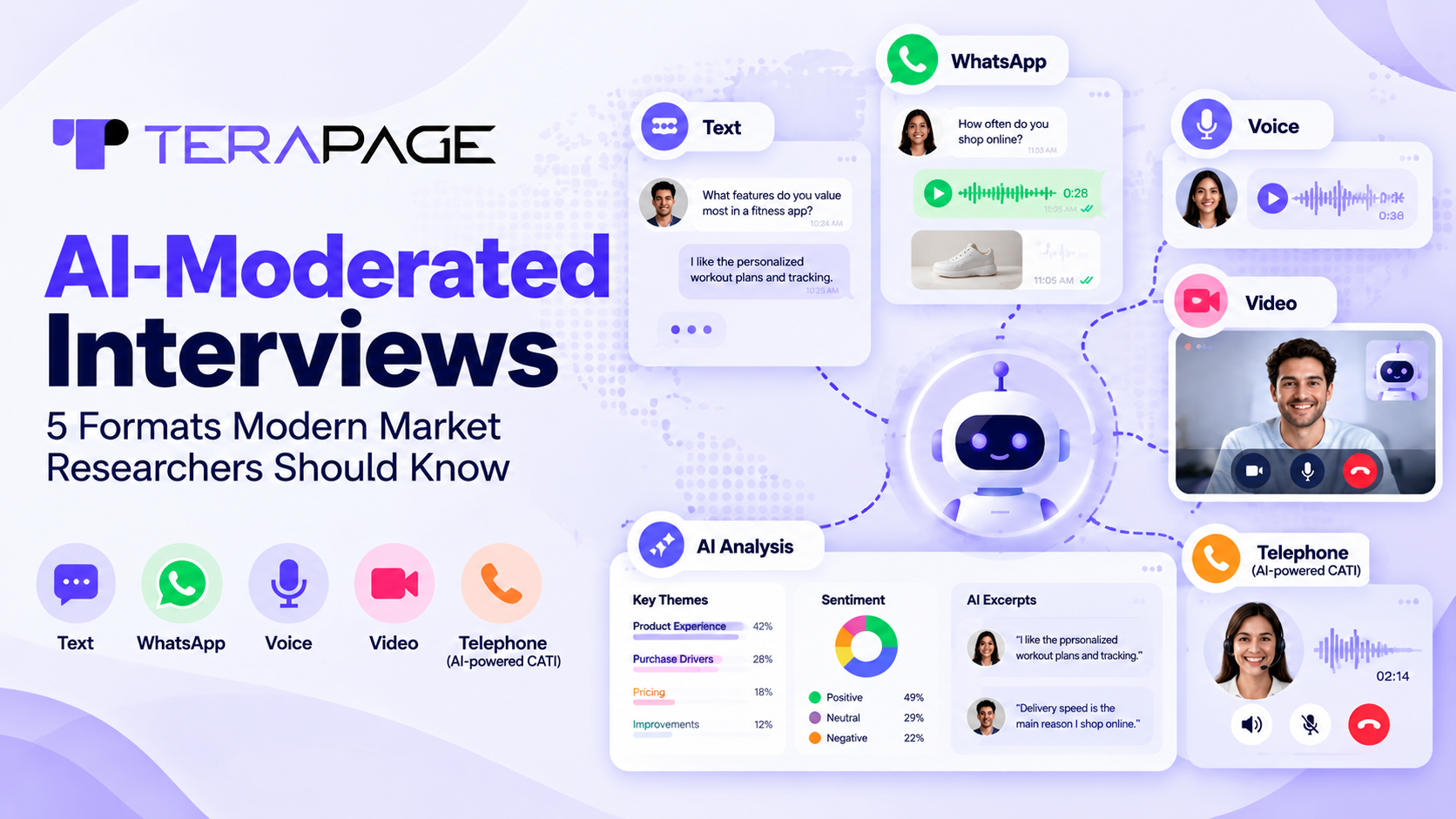
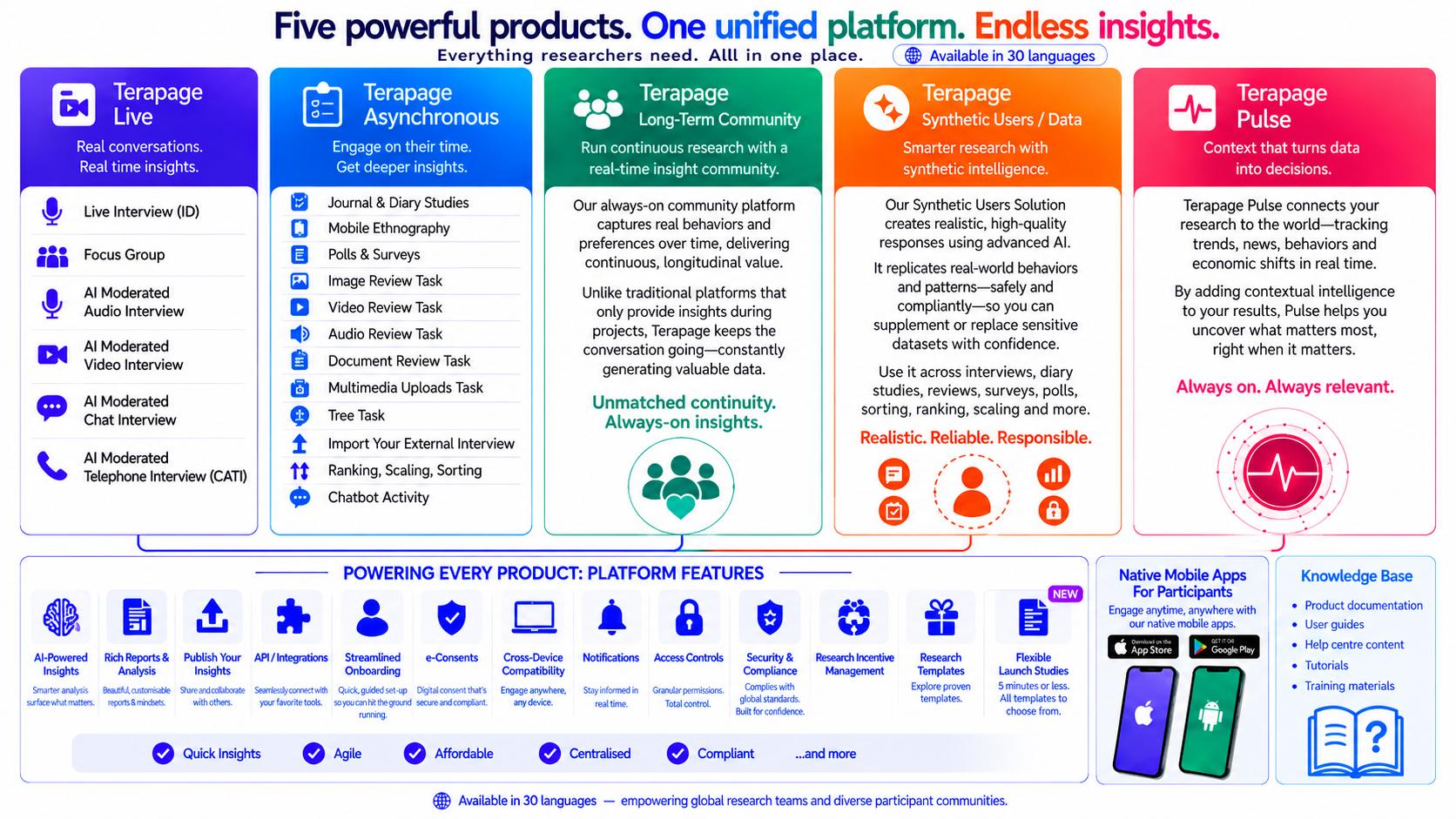
- There are five AI-moderated interview formats on Terapage: text, WhatsApp, voice, video and telephone (AI-powered CATI).
- Text, WhatsApp, voice and video interviews share one four-step set-up; telephone interviews add campaign, participant import, test-call and compliance steps.
- The right format depends on who your participants are and what you need to learn, from considered written answers to emotion, reactions and reach without internet.
- Every format feeds the same AI analysis: searchable transcripts, speech maps, sentiment and intensity, AI excerpts and quote analysis.
AI has moved from experiment to everyday business practice. According to Amazon’s 2026 Unlocking Europe’s AI Potential research, 54% of European businesses now use AI, up from just 33% two years earlier. Market research is changing just as fast. Teams are expected to deliver deeper insight from more conversations, in more markets, in less time.
AI-moderated interviews meet that demand. One AI moderator can run hundreds of interviews at once, and each conversation keeps the depth of a one-to-one interview. But the format matters as much as the moderator: a busy shopper may prefer to reply on WhatsApp, while a rural respondent may only answer the phone.
This guide covers the five formats of AI-moderated interviews on Terapage: text, WhatsApp, voice, video and telephone. For each one, it explains when the format works best, how a study is set up and how the data is analysed.
What Is an AI-Moderated Interview?
An AI-moderated interview is a research interview led by an AI moderator. It is built on conversational AI, which IBM describes as technologies “such as chatbots or virtual agents, that users can talk to.” The AI moderator asks your questions, listens to each answer, follows up when an answer is vague or interesting, and records everything for analysis.
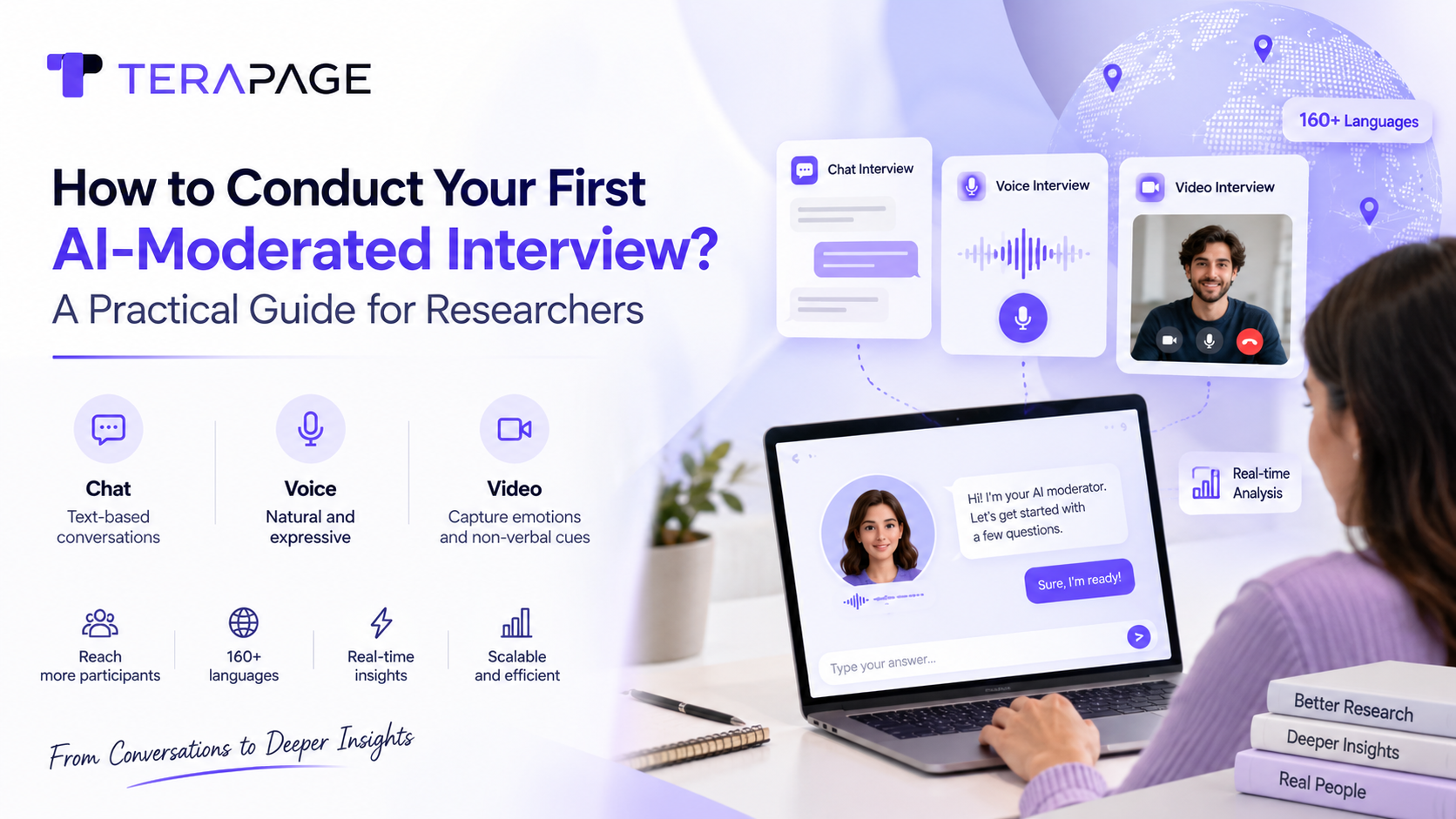
Instead of a fixed script, the AI moderator follows a discussion guide and responds to what each participant says, much like an experienced interviewer. New to the method? Start with this guide to conducting your first AI-moderated interview.
How Does an AI-Moderated Interview Work?
Researchers set up the study once, and the AI moderator then runs every interview, asks follow-up questions and records each answer for analysis. Text, WhatsApp, voice and video interviews share the same four-step set-up, while telephone interviews have their own.
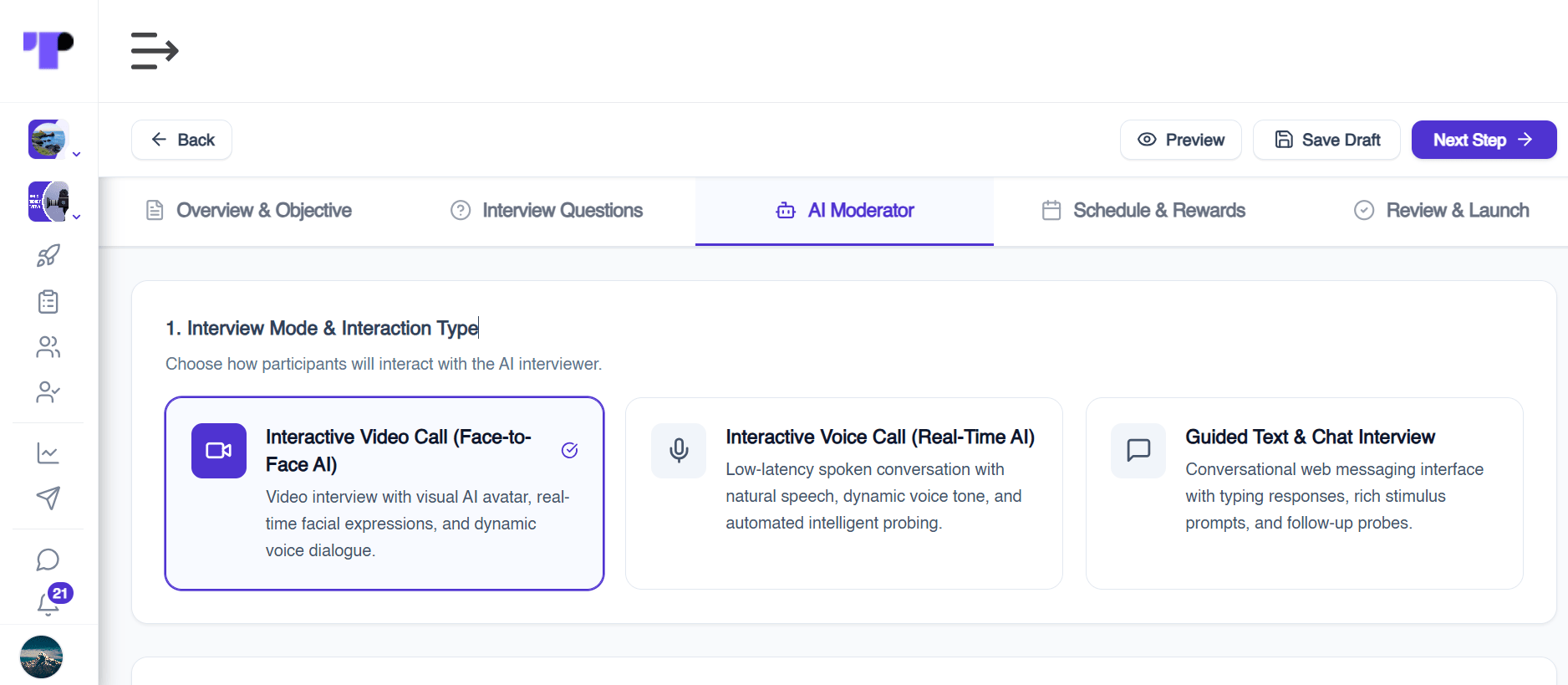
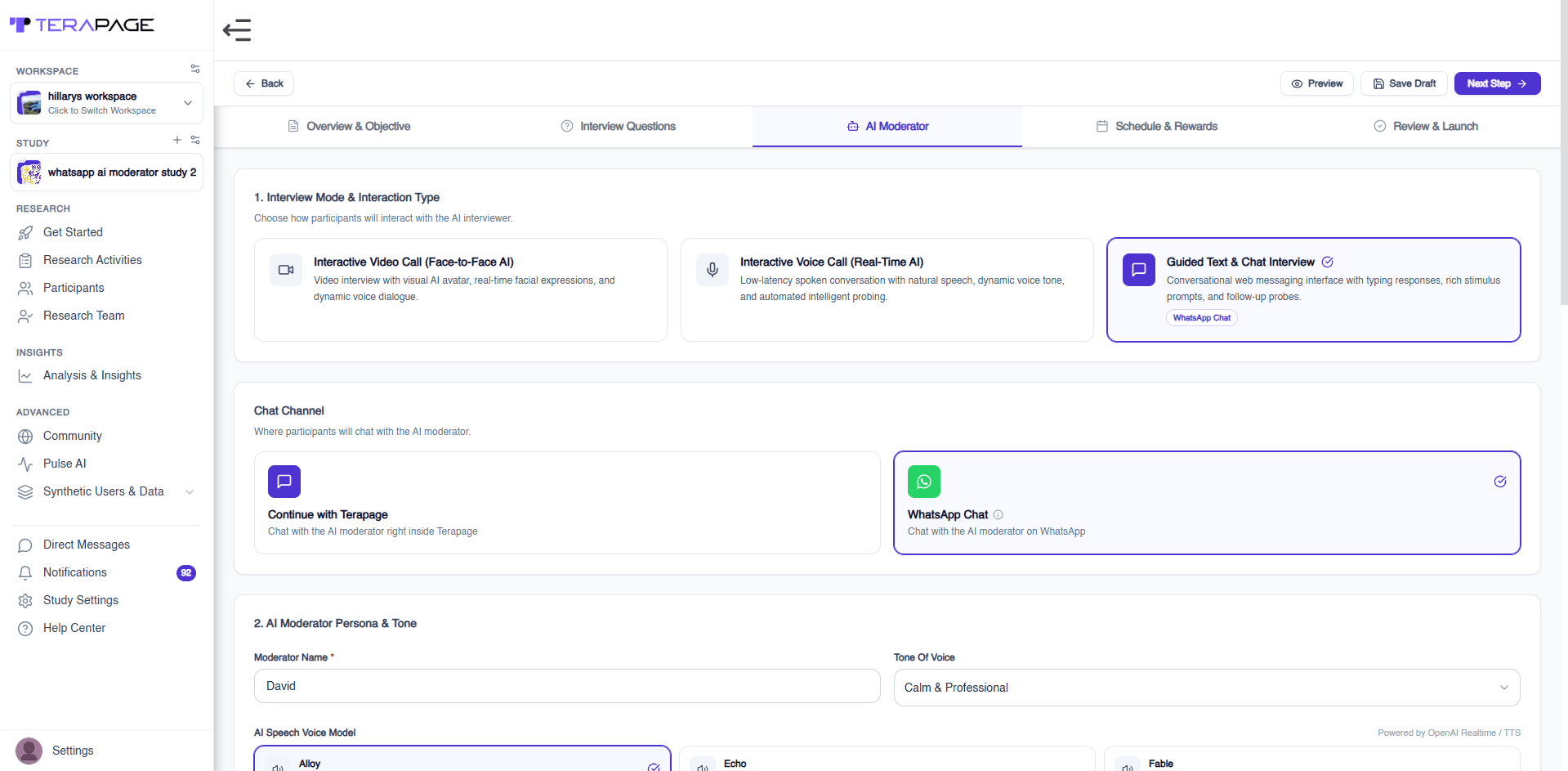
1. Choose the AI-Moderated Interview Format
Researchers start by choosing how participants will interact with the AI moderator: an interactive video call, an interactive voice call or a guided text and chat interview. Chat interviews can also run on WhatsApp.
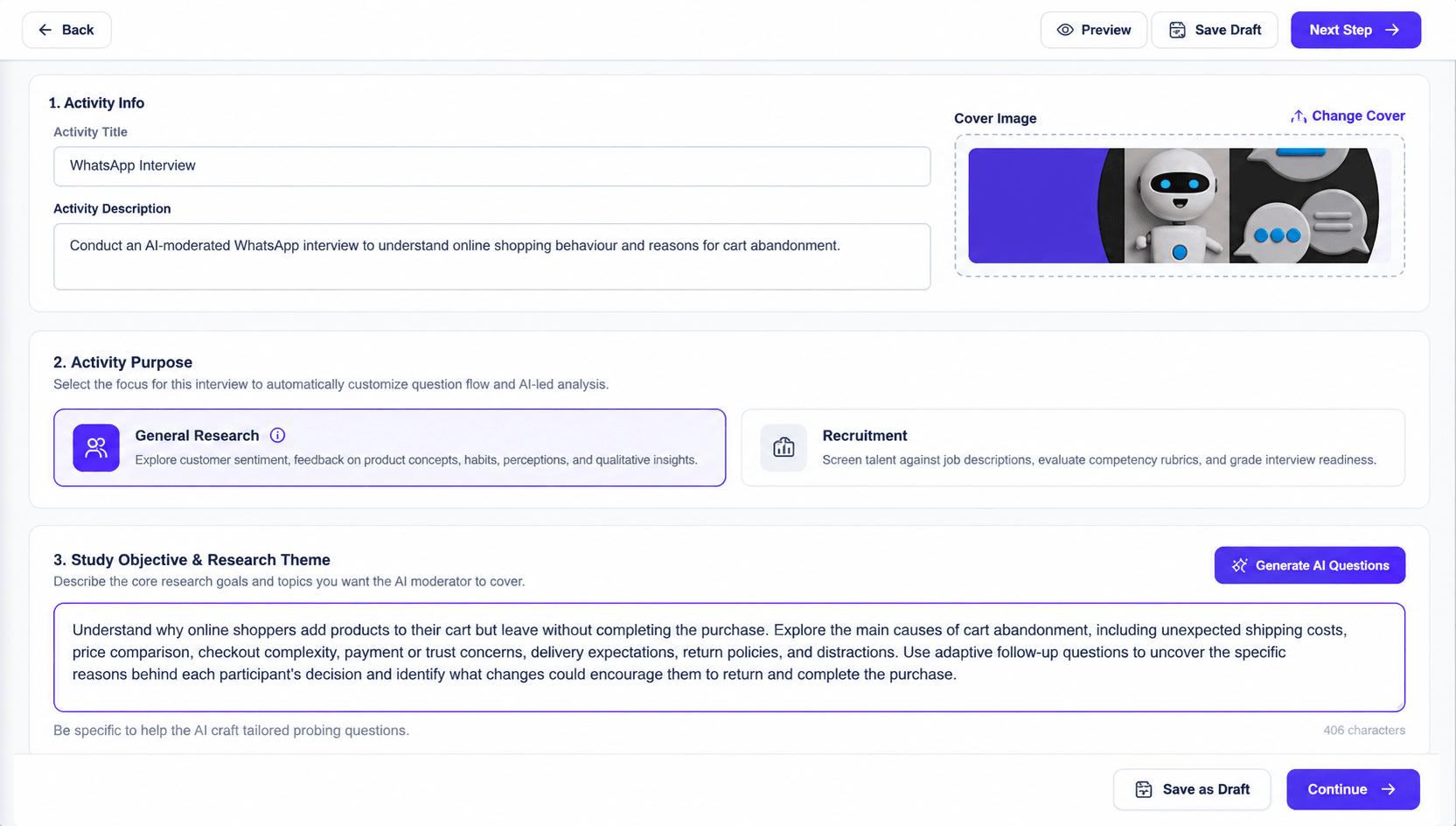
2. Add the Study Objective, Questions and AI Probes
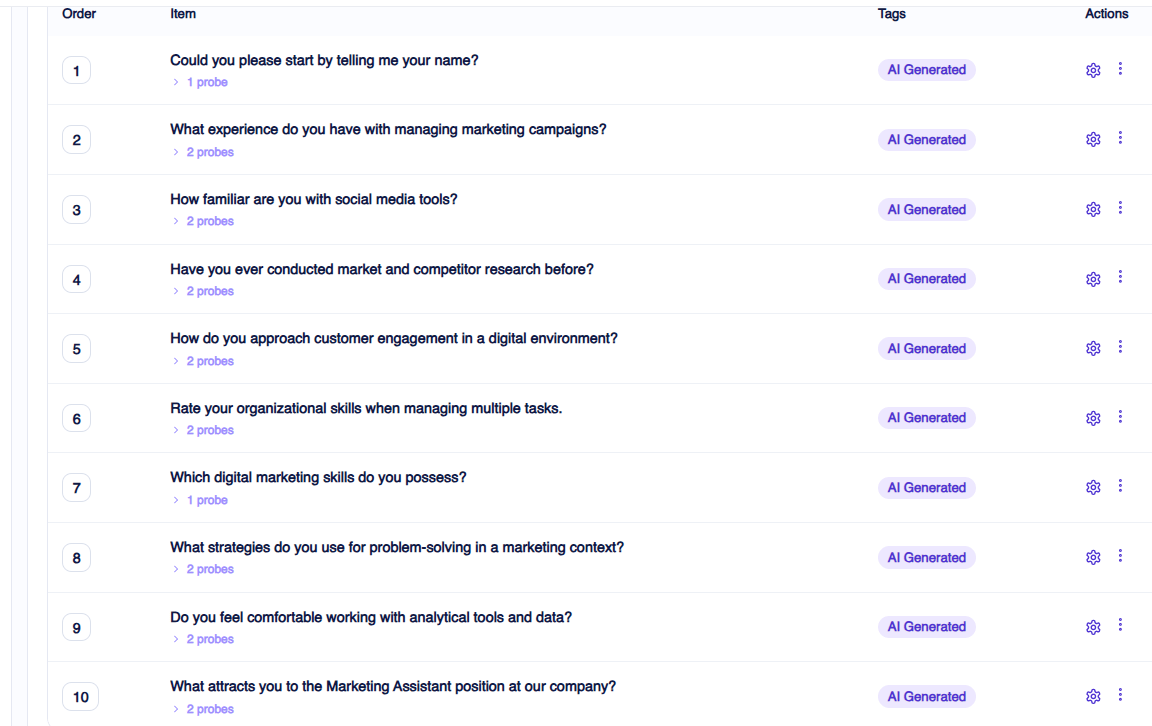
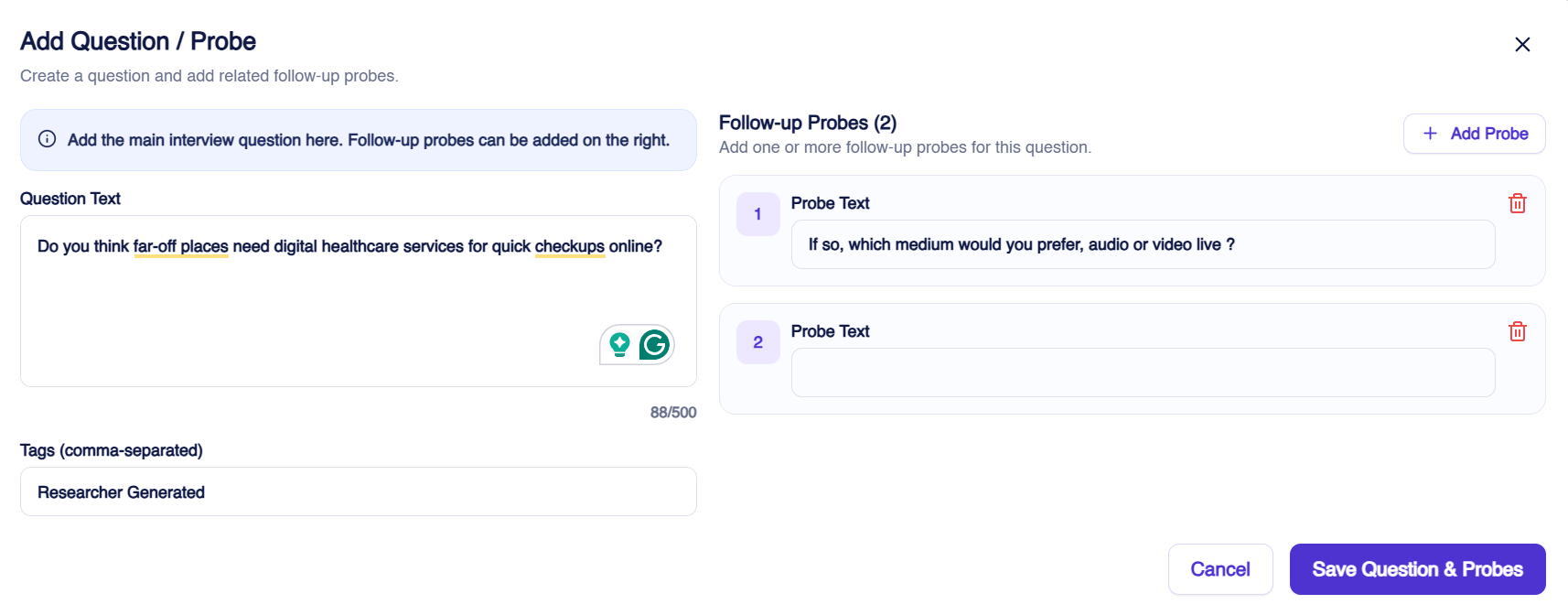
Next, researchers describe the study objective and research theme, and AI can generate the interview questions from it. Each question can then carry follow-up probes, which researchers write themselves or let AI suggest, so the moderator asks for more detail whenever an answer is short or unclear.
3. Set Up the AI Moderator
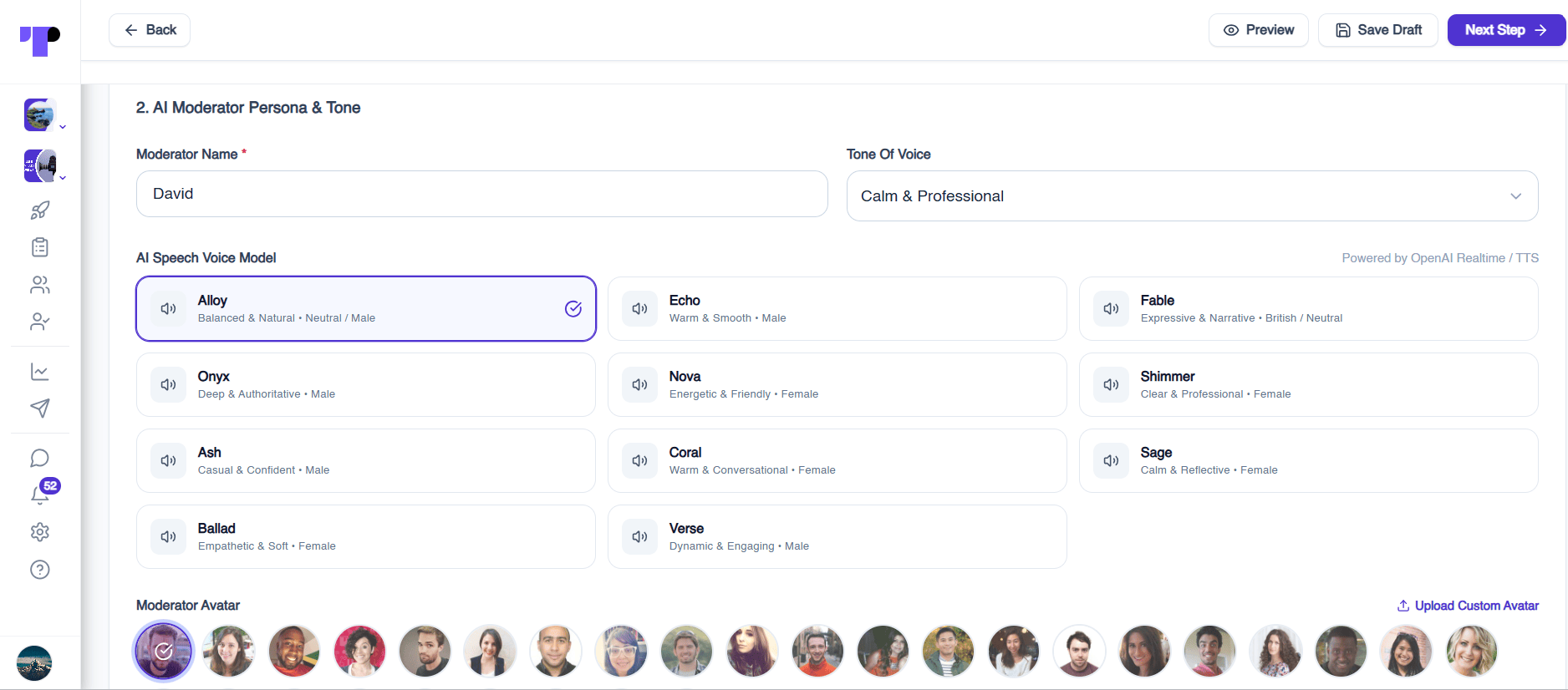
Researchers choose the moderator’s name, tone of voice, speech voice and avatar once. Every participant then hears questions asked in the same way, which keeps interviews consistent and free from interviewer bias.
4. Review and Launch the Interview
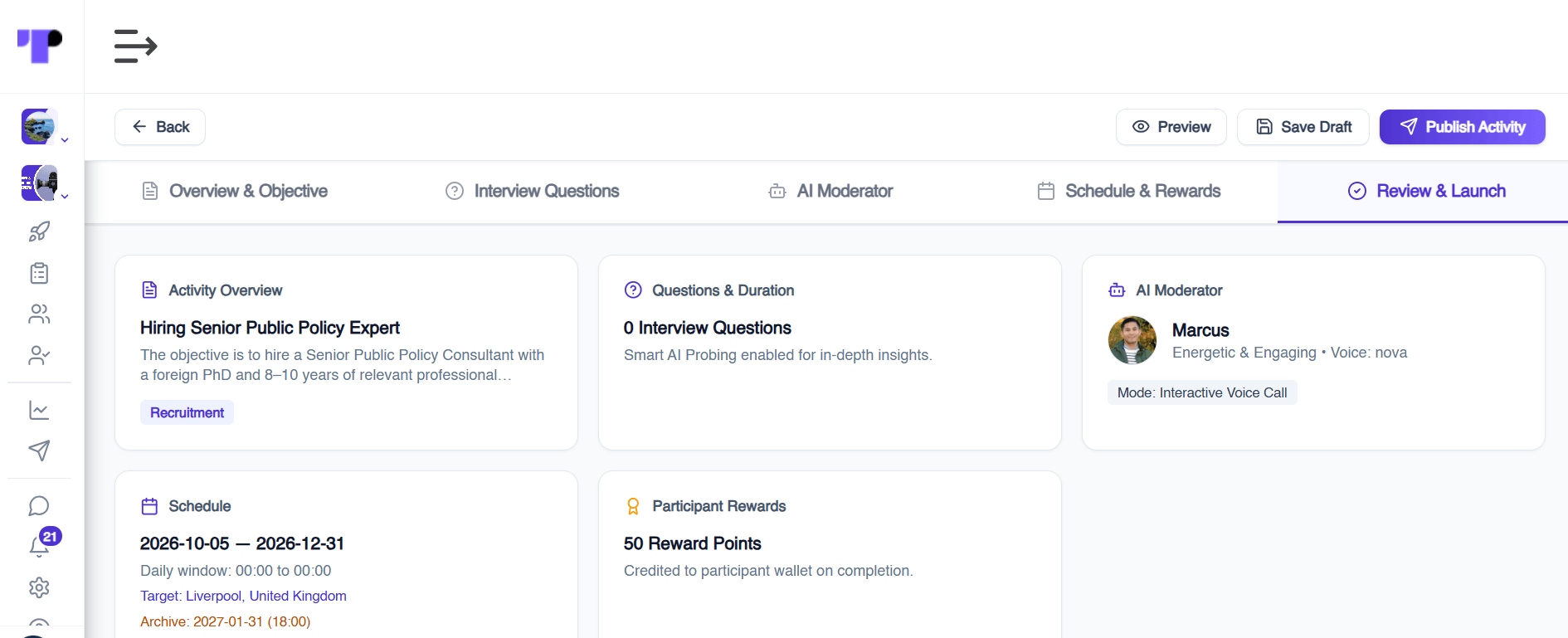
Finally, researchers check the activity overview, questions, AI moderator, schedule and participant incentives on one screen. Participants can come from the existing study, an insight community or participant recruitment, and the interview is published in one click.
What Are the 5 Formats of AI-Moderated Interviews?
Every format uses the same AI moderator, adaptive probing and analysis. What changes is how participants take part. On Terapage, they can join on any device, through the channel that suits them best.
1. Text-Based AI-Moderated Interviews
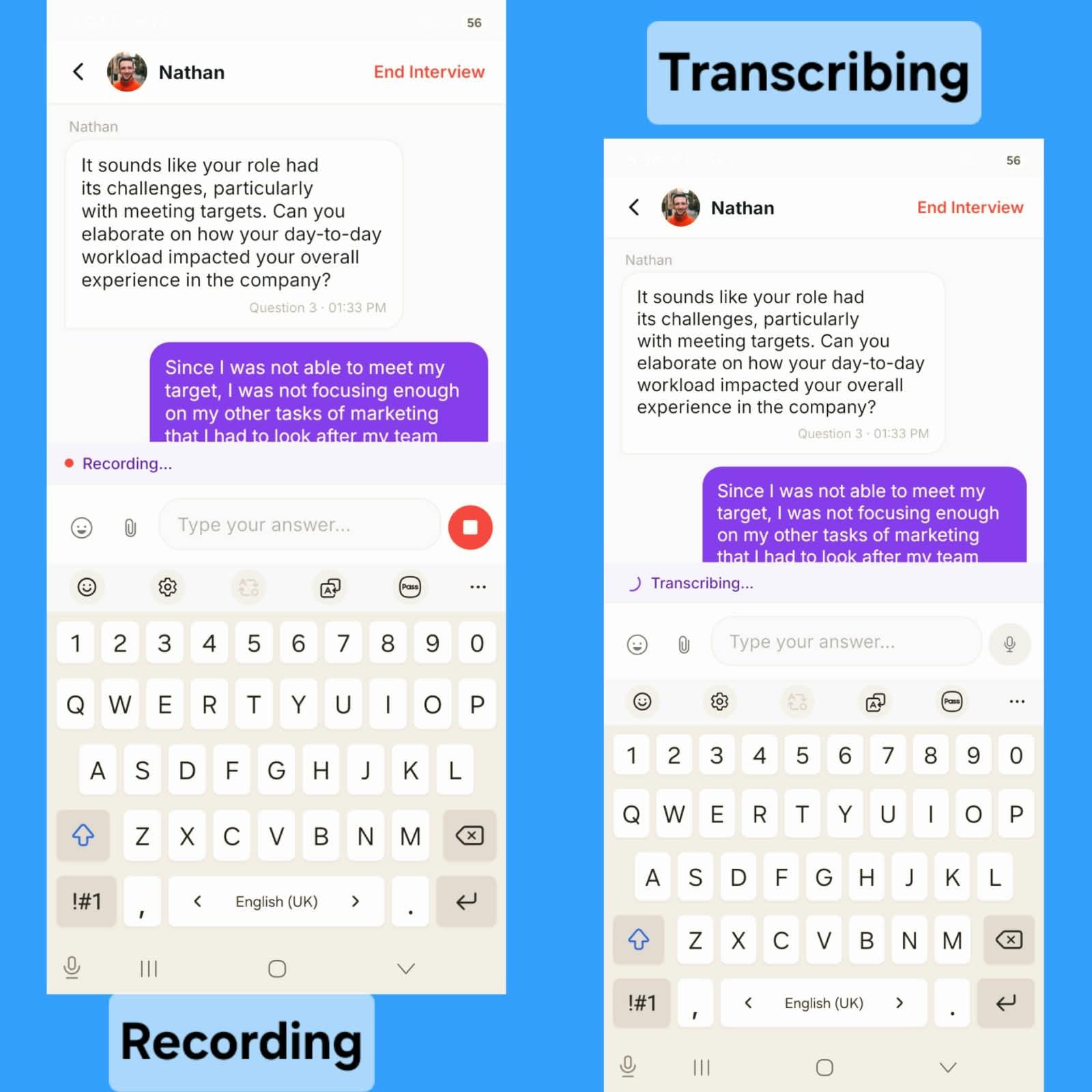
In a text-based interview, participants type their answers at their own pace, usually on their phone. The AI moderator reads each reply and follows up on it, for example by asking participants to walk through a real example instead of giving a general opinion. When the interview ends, responses are saved instantly for analysis.
Best for:
- Sensitive topics where participants prefer privacy
- Participants who like to think before they answer
- Studies that need clean written responses with no transcription
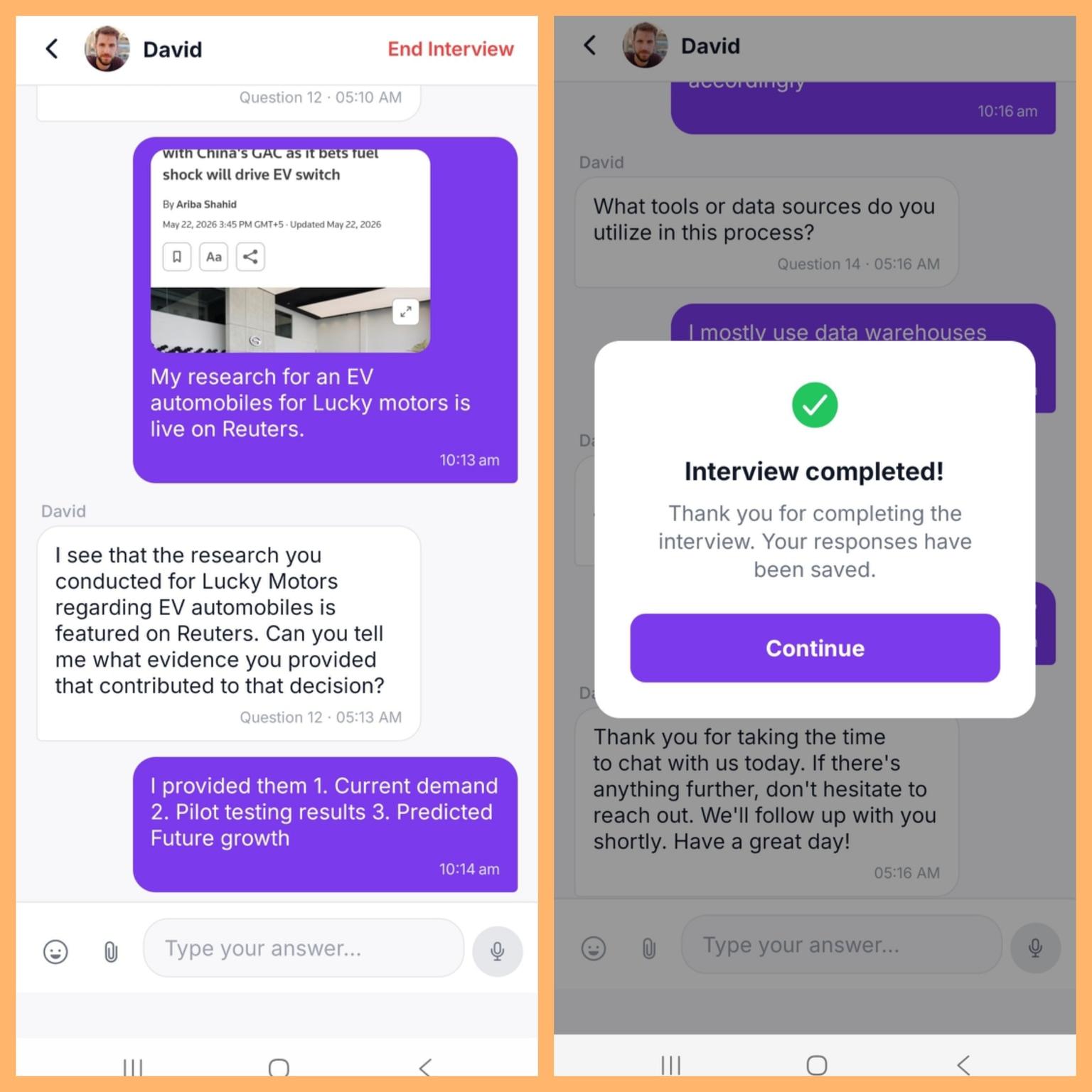
Participants who prefer not to type can record their answer instead, and it is transcribed straight into the chat. Read more about what works in AI-moderated chat interviews.
2. WhatsApp-Based AI-Moderated Interviews
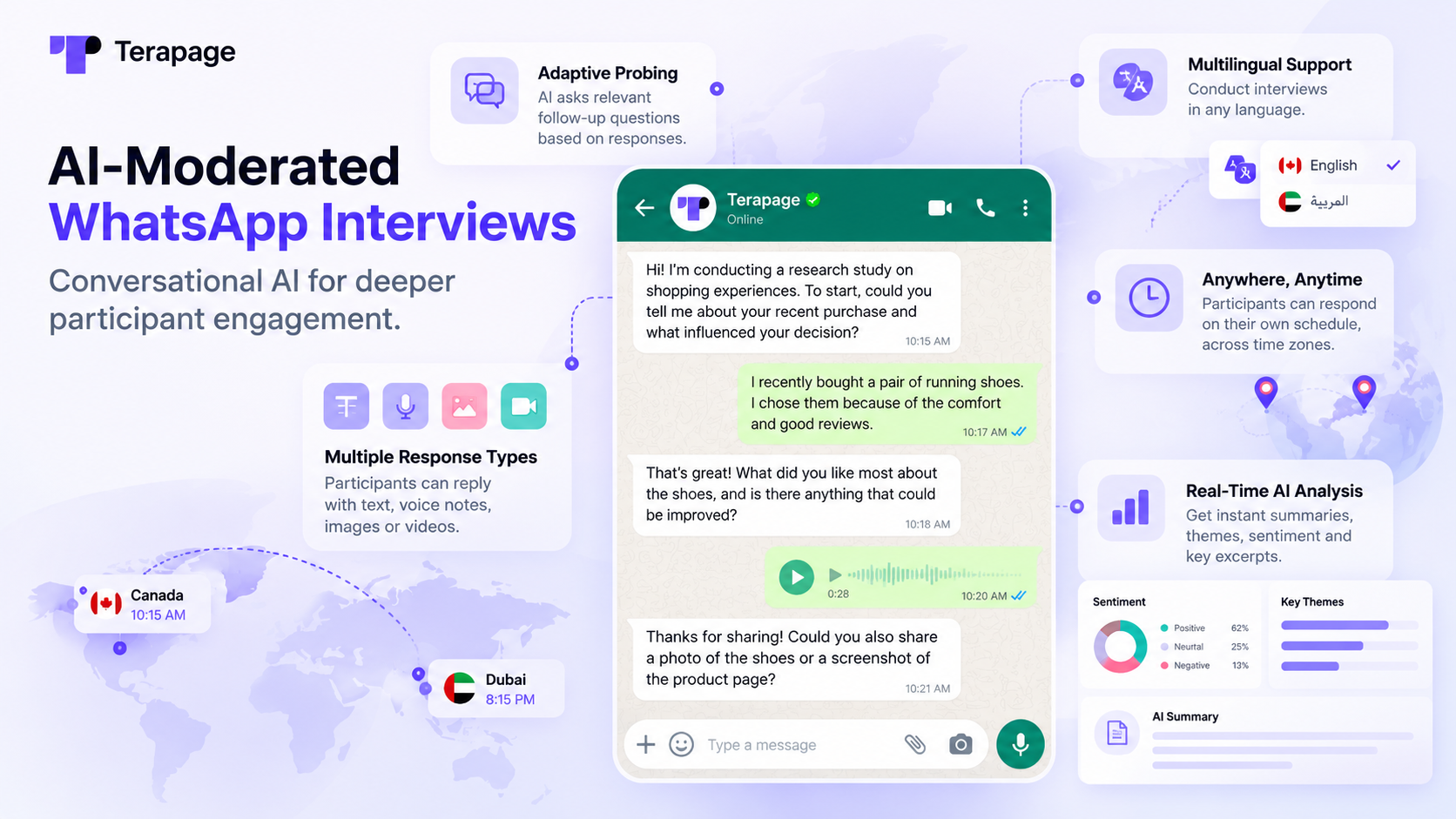
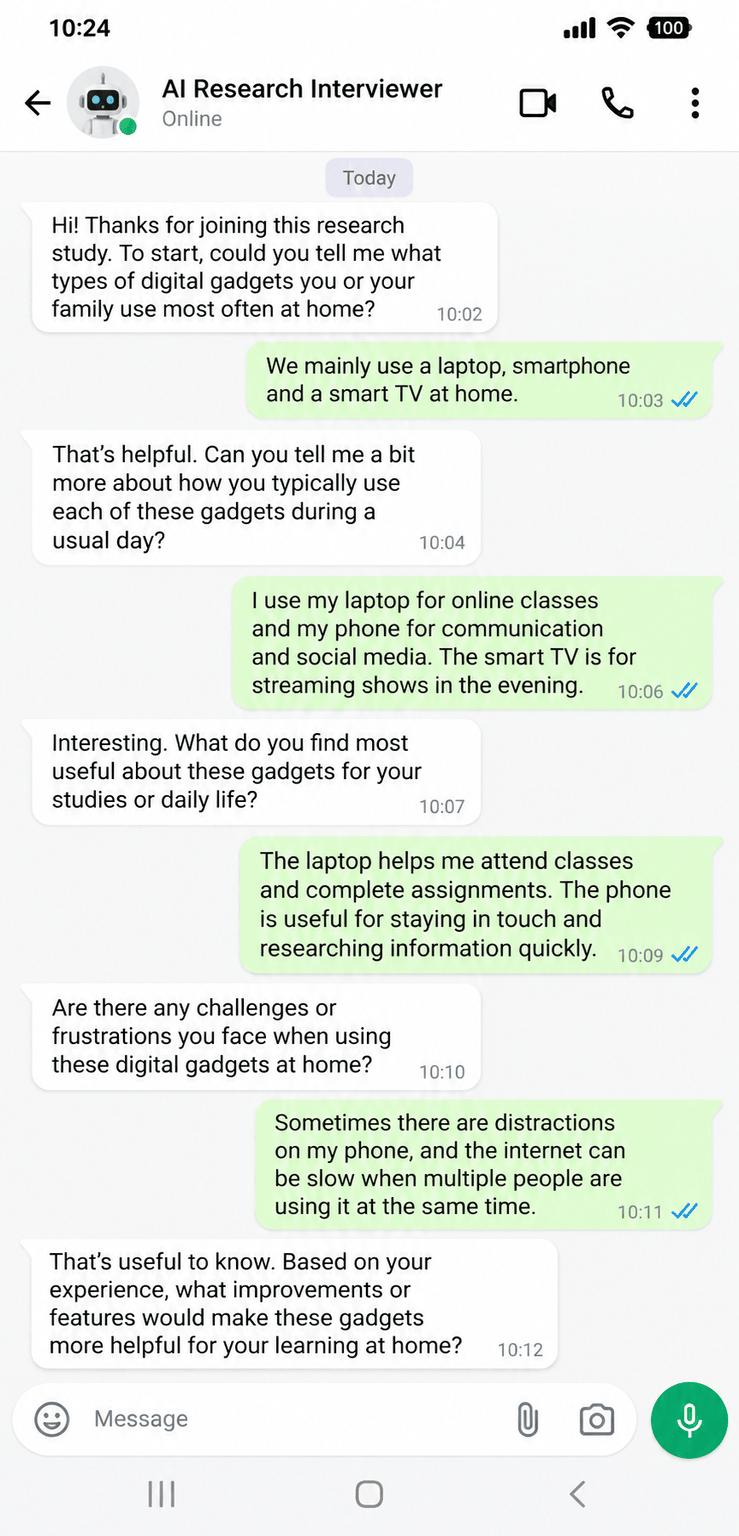
In a WhatsApp-based AI-moderated interview, participants take part on a messaging app they already use every day. Researchers simply select WhatsApp as the chat channel during set-up. Participants can reply with text or voice notes, and the AI moderator follows up on each answer.
Best for:
- Consumer and mobile-first audiences
- Shopper and usage studies for consumer goods and services
- Markets where WhatsApp is the main way people communicate
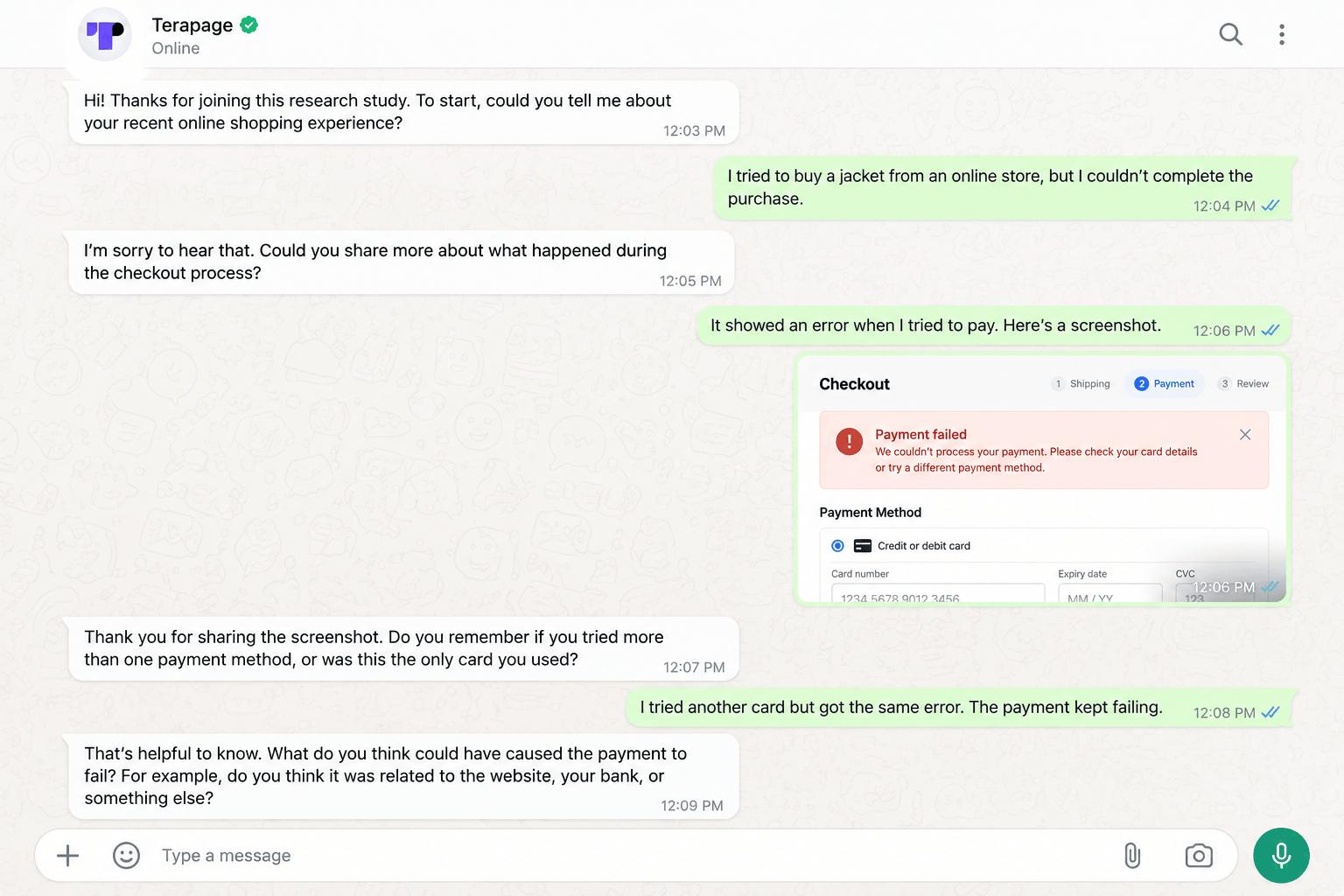
Participants can also share photos and screenshots during the conversation, such as an error message from a failed checkout, and the AI moderator probes for more detail.
3. Voice-Based AI-Moderated Interviews
In a voice-based AI-moderated interview, participants speak naturally with the AI moderator, just as they would on a call. Every answer is transcribed live, so tone, hesitation and detail are captured without anyone taking notes. Learn how AI-led automated interviews are transforming conversational research.
Best for:
- Participants who find speaking easier than typing
- Emotional or experience-led topics
- Longer stories that lose detail in text
4. Video-Based AI-Moderated Interviews
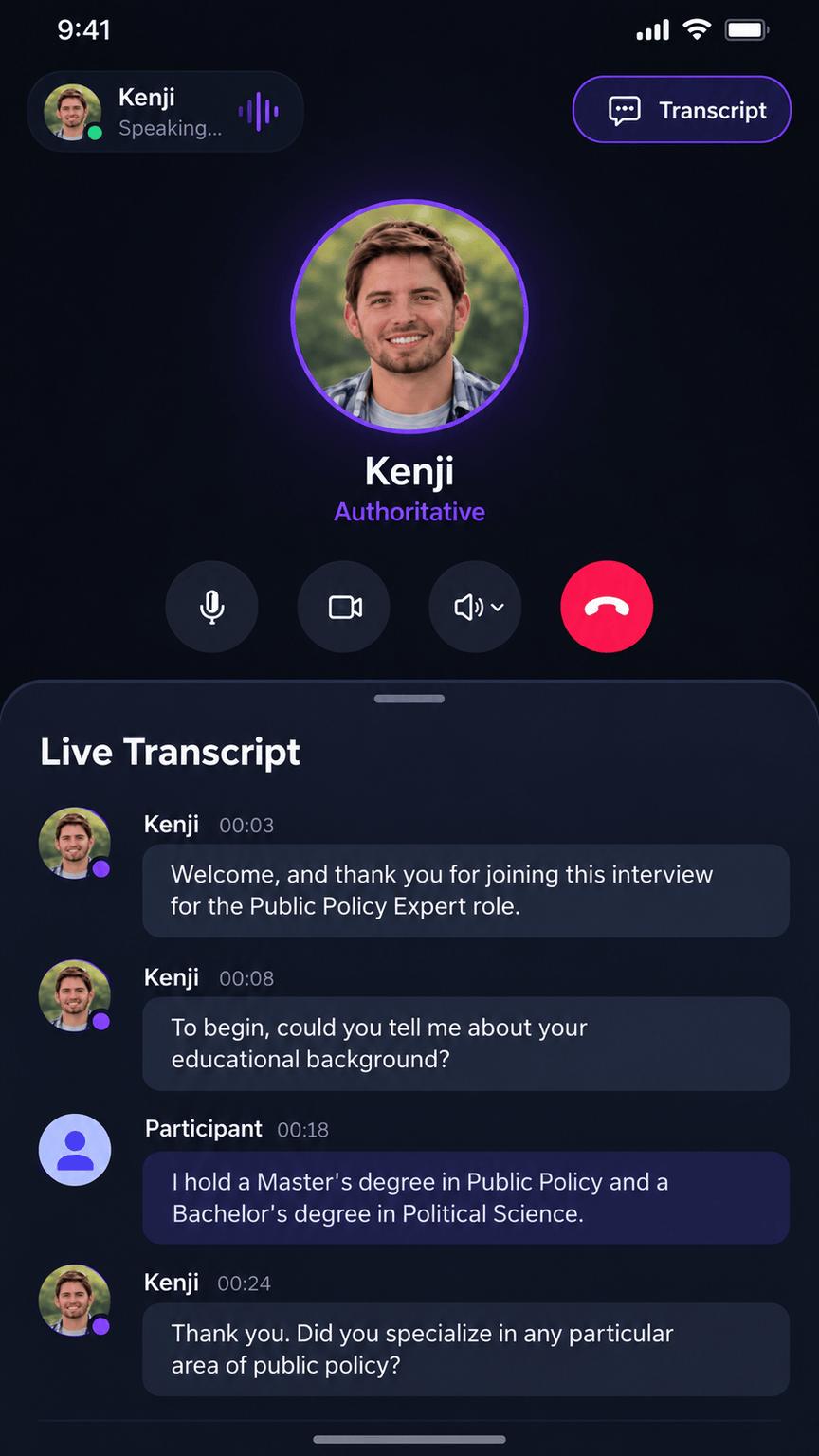
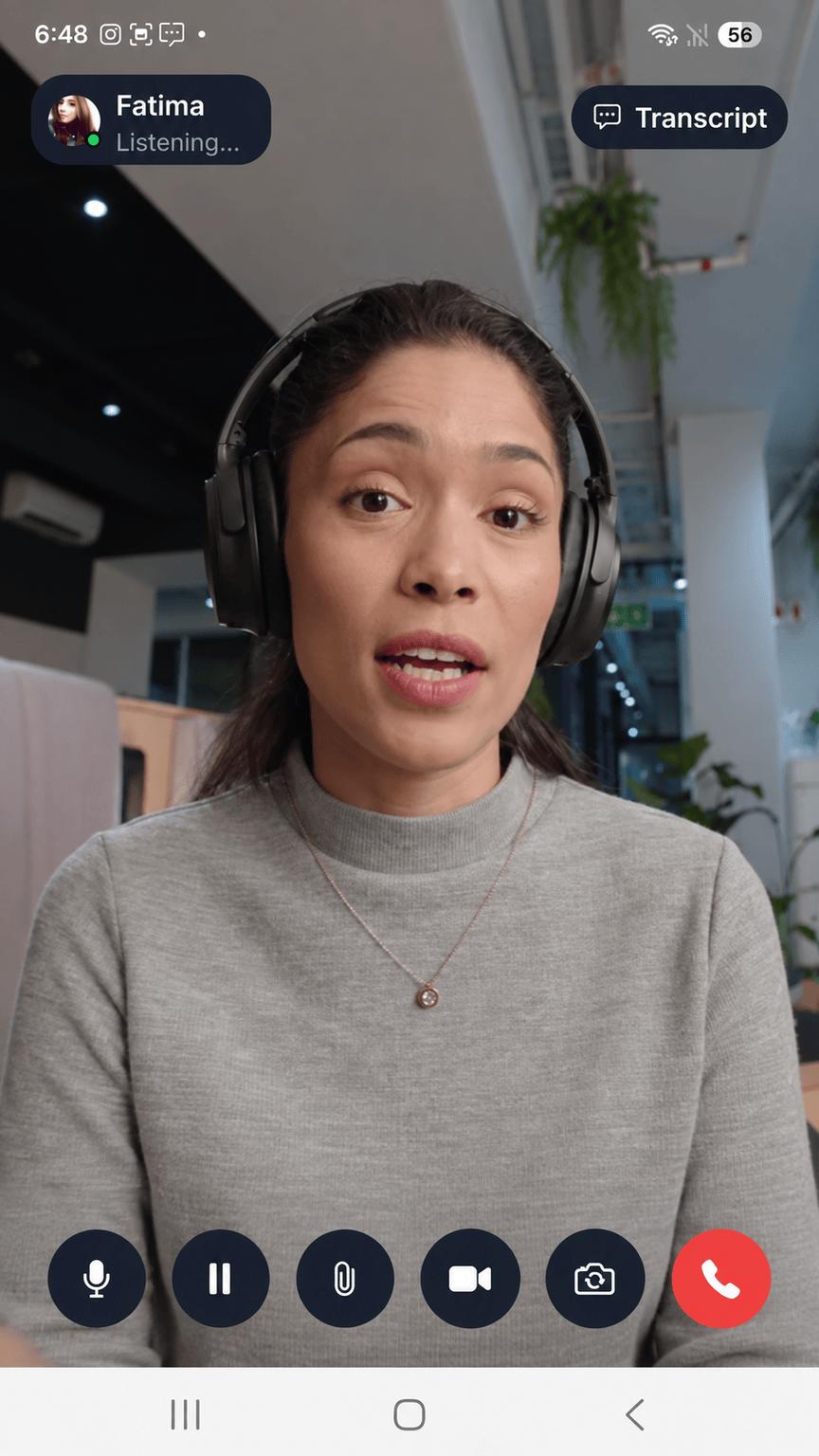
In a video-based AI-moderated interview, the AI moderator appears as an avatar with real-time facial expressions. It listens to each answer and keeps a live transcript, much like a face-to-face interview. Researchers can preview the interview before launch. Our step-by-step guide to AI-moderated video interviews walks through the full set-up.
Best for:
- User experience research
- Concept, ad and product testing, such as online qualitative concept testing
- Studies where seeing reactions adds meaning
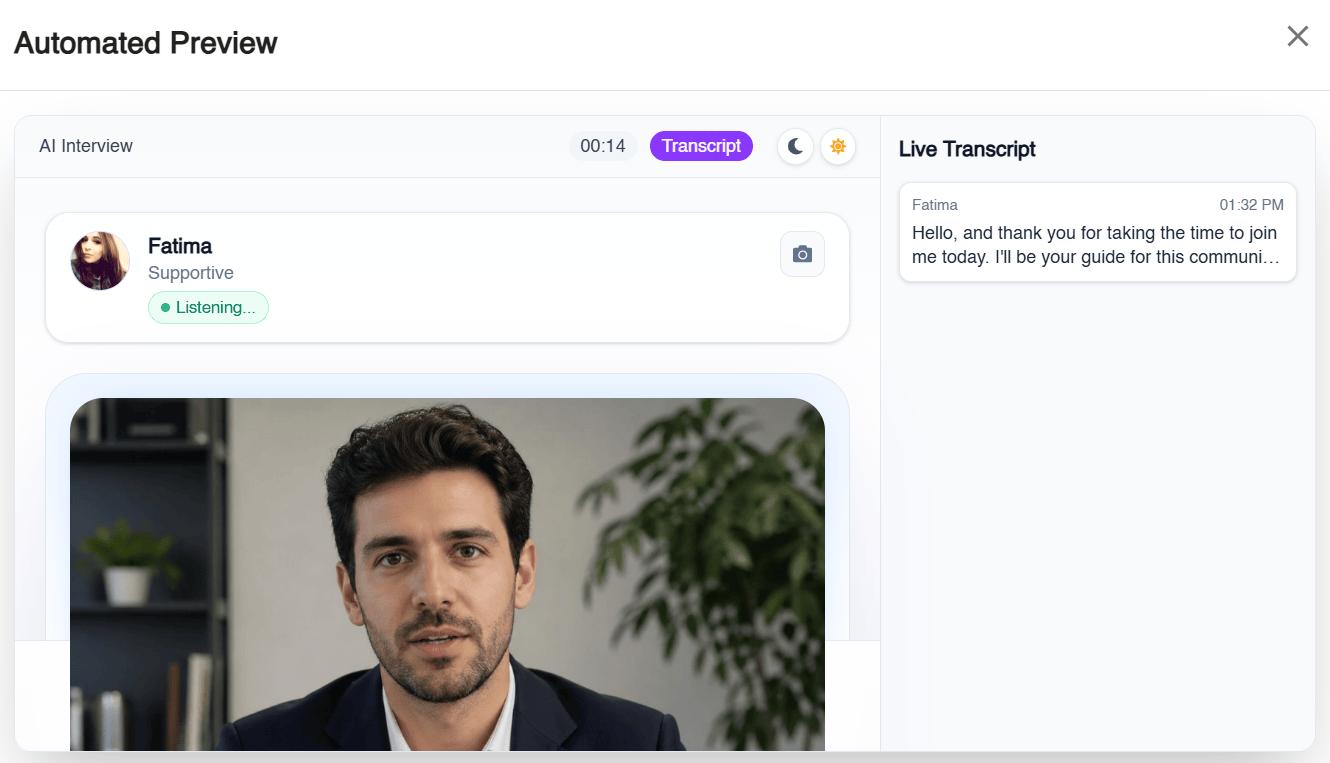
Participants can join from a laptop or a mobile phone, so they can take part from wherever they are.
5. AI-Moderated Telephone Interviews (AI-Powered CATI)
In AI-moderated telephone interviews, the AI moderator calls participants at scheduled times and conducts the interview naturally, asking questions and following up just as it does in the other formats. This brings AI to traditional phone-based research without the need for a call centre.
Best for:
- Participants who prefer phone calls
- Audiences with limited internet access
- Large-scale fieldwork with wide geographic reach
- Public health and healthcare research across regions
How to Set Up an AI-Moderated Telephone Interview
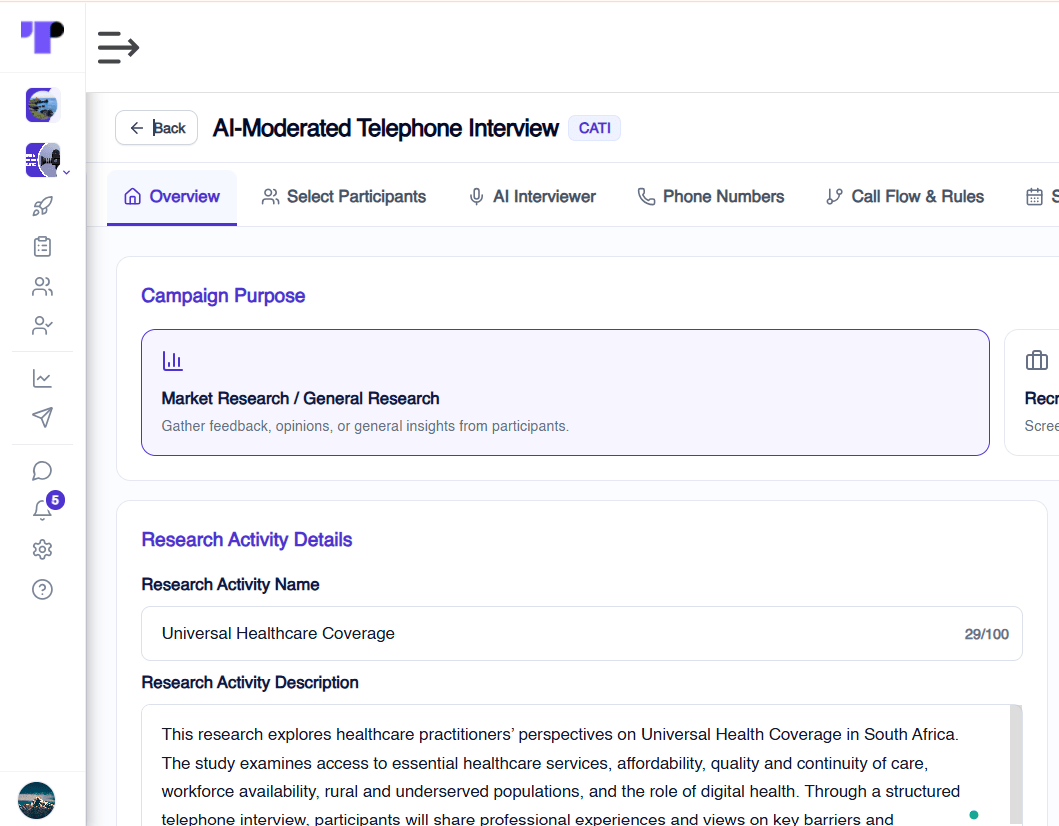
- Create the campaign: Researchers choose the campaign purpose, such as market research or recruitment, and add the research activity name and description.
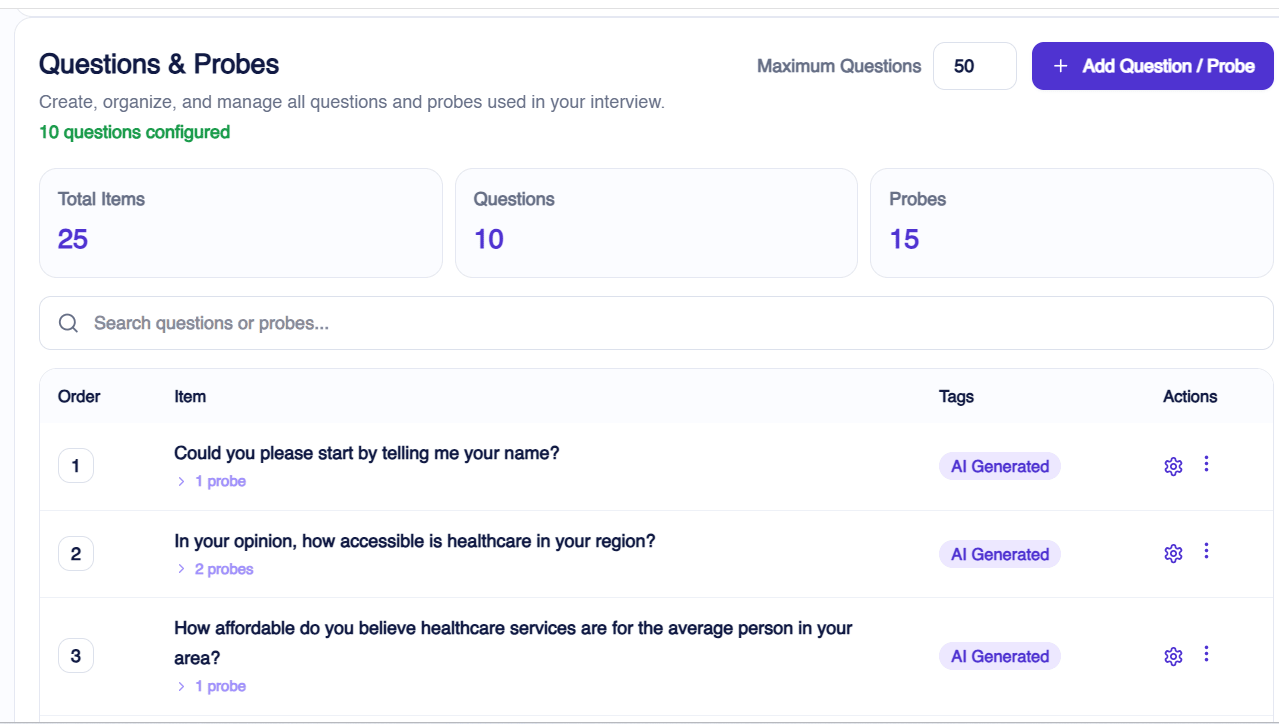
- Add questions and probes: AI drafts the questions and follow-up probes from the study description, and researchers review, edit or add to them before any calls are made.
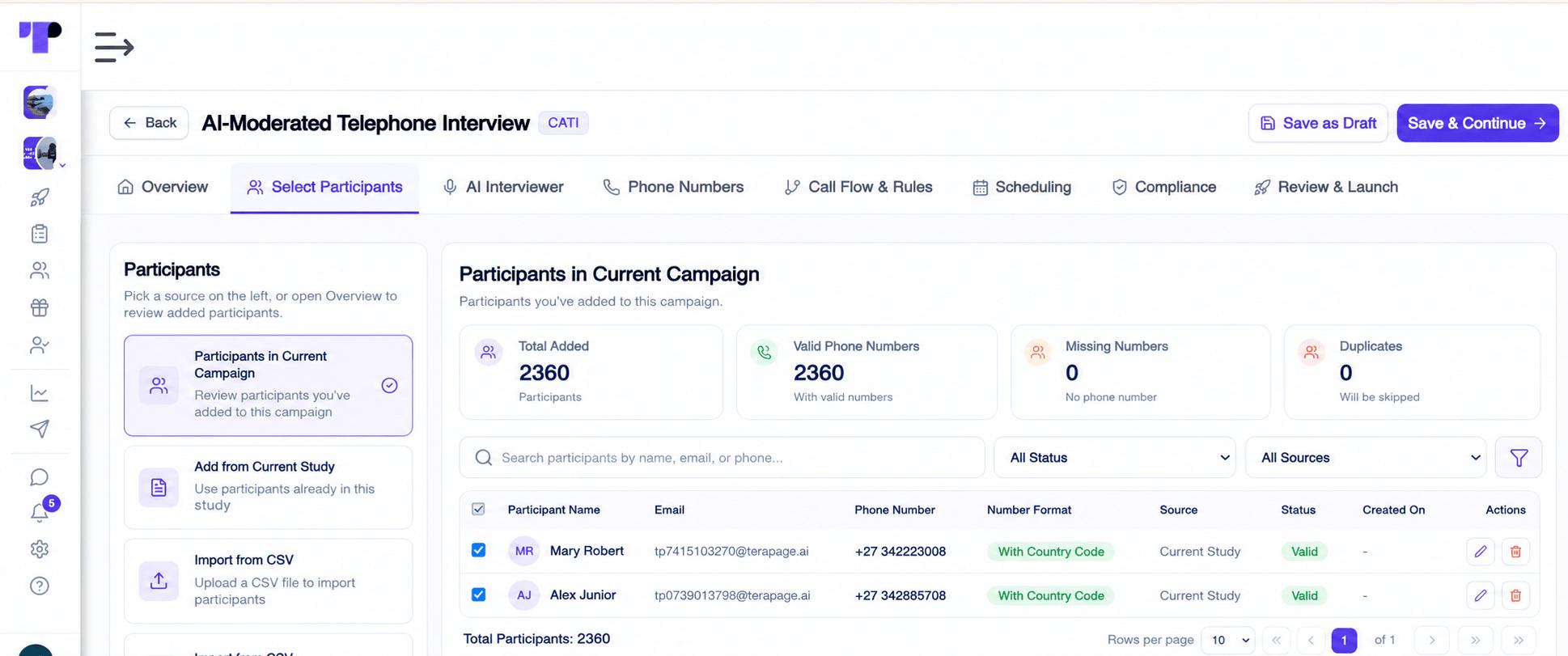
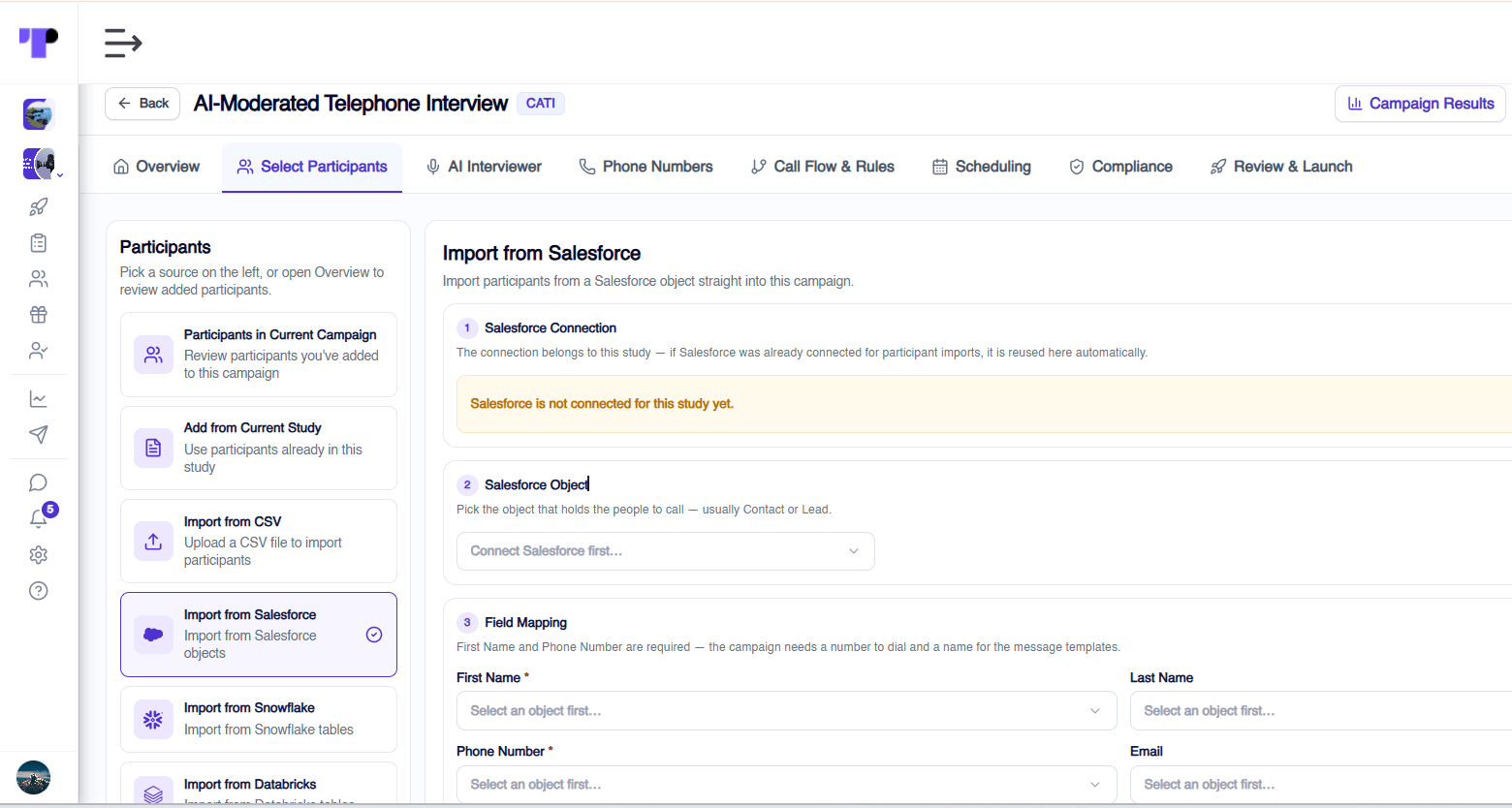
- Add participants: Participants can come from the current study, a CSV file or connected tools such as Salesforce, with phone numbers checked automatically for missing or duplicate entries.
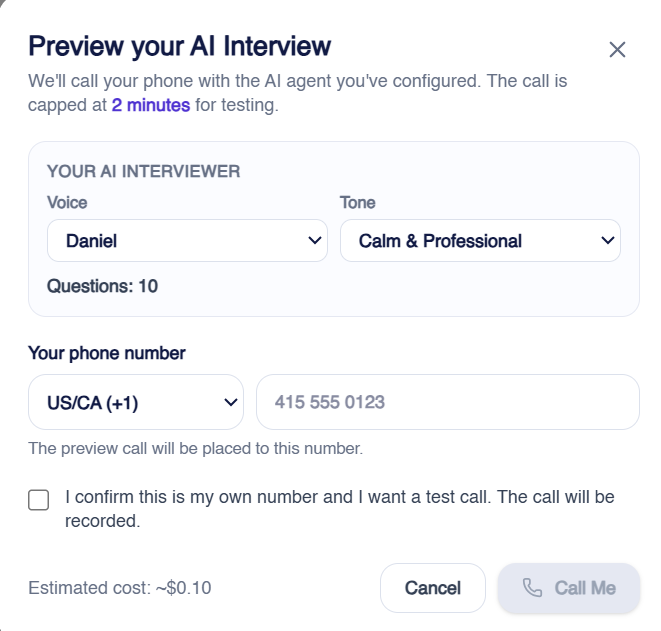
- Preview the call: Before launch, researchers choose the AI interviewer’s voice and tone, then place a short test call to their own phone to hear the interview exactly as participants will.
5. Compliance Built Into Every Call
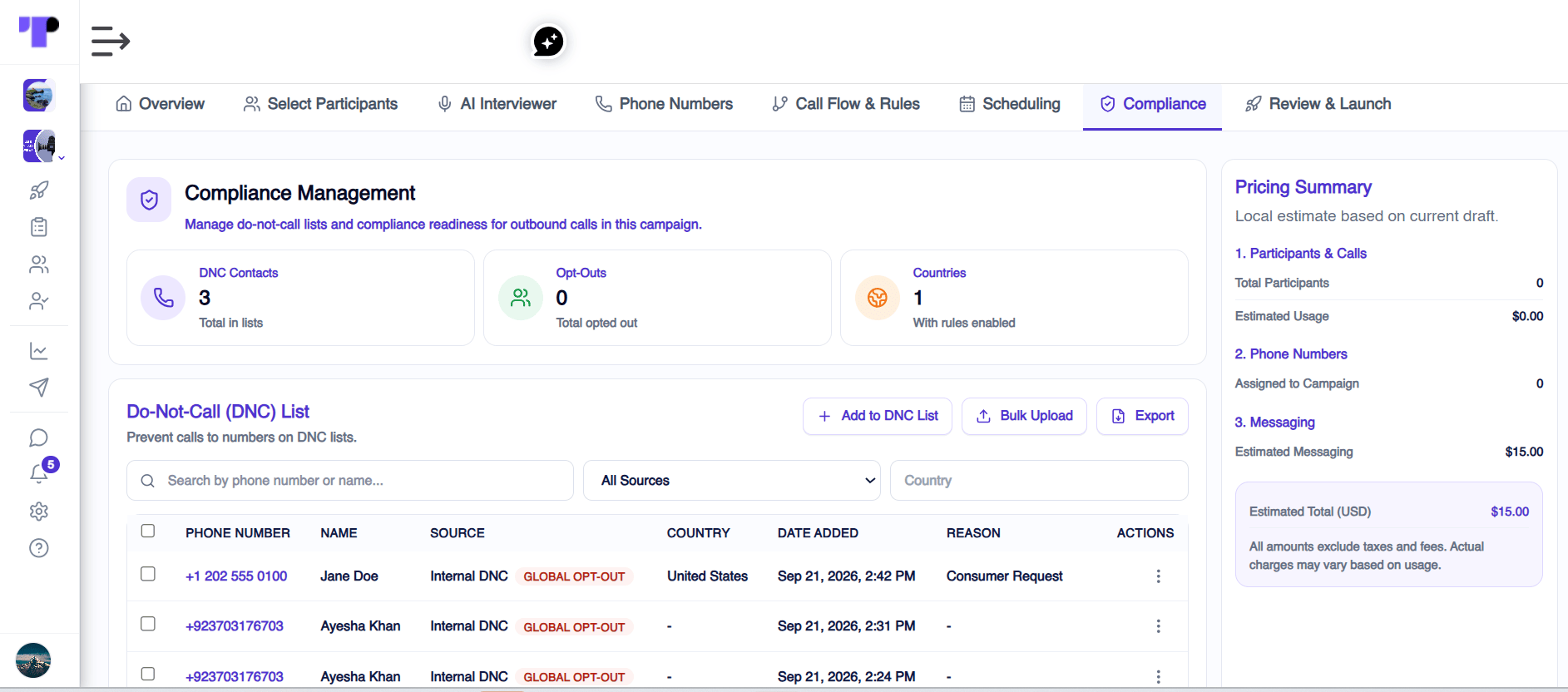
Compliance is managed inside the campaign. Researchers can keep a Do-Not-Call list, track opt-outs and check country rules before calls go out, so every participant is contacted responsibly.
6. Tracking and Analysing AI Telephone Interview Results
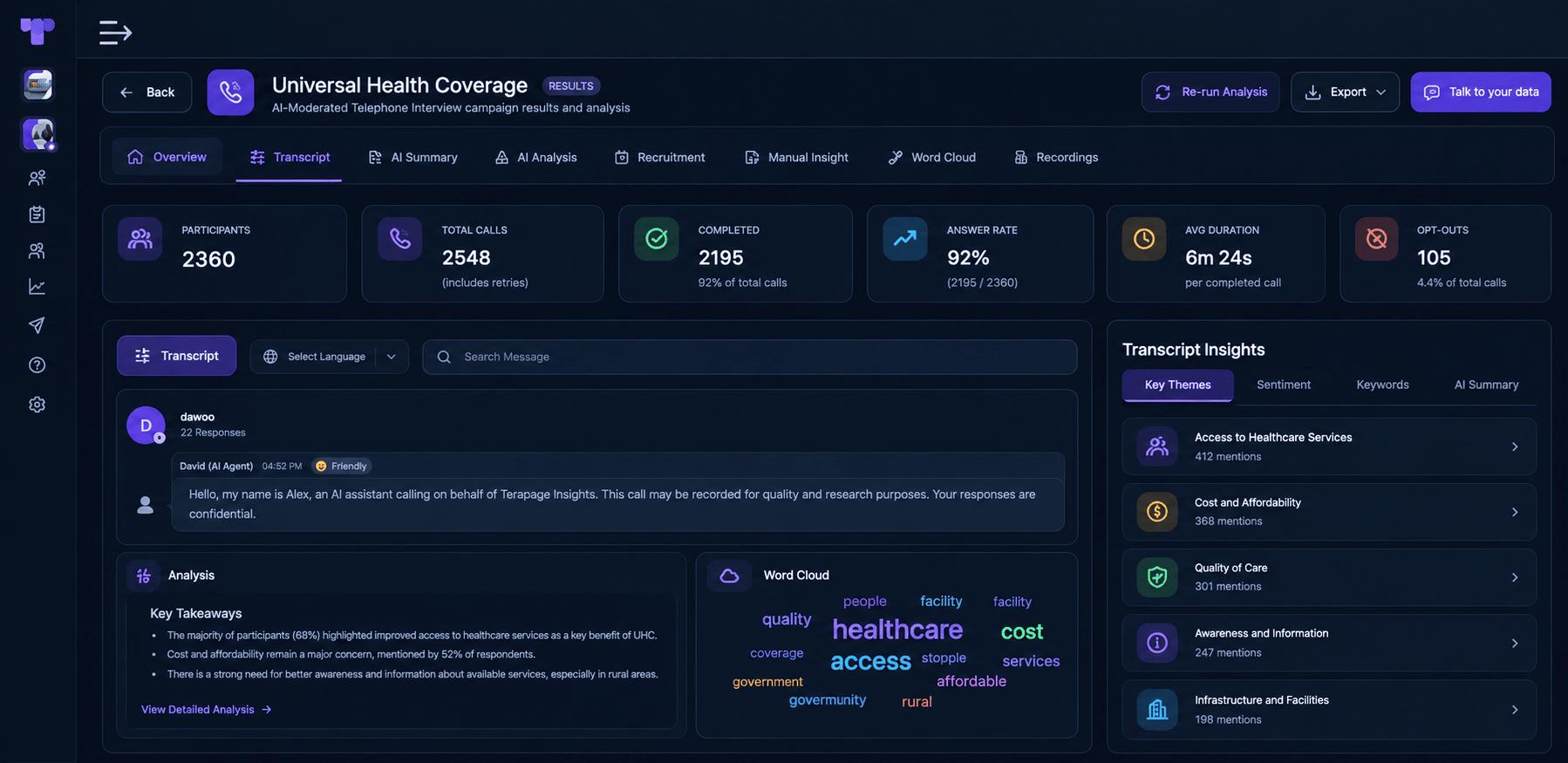
Once calls begin, one dashboard tracks participants, total calls, completions, answer rate, average duration and opt-outs. Researchers can read every transcript, review key takeaways, transcript insights and a word cloud, and use Talk to your data to ask questions in plain language. Read more about how AI telephone interviews work, or how recruitment teams use them to screen candidates faster.
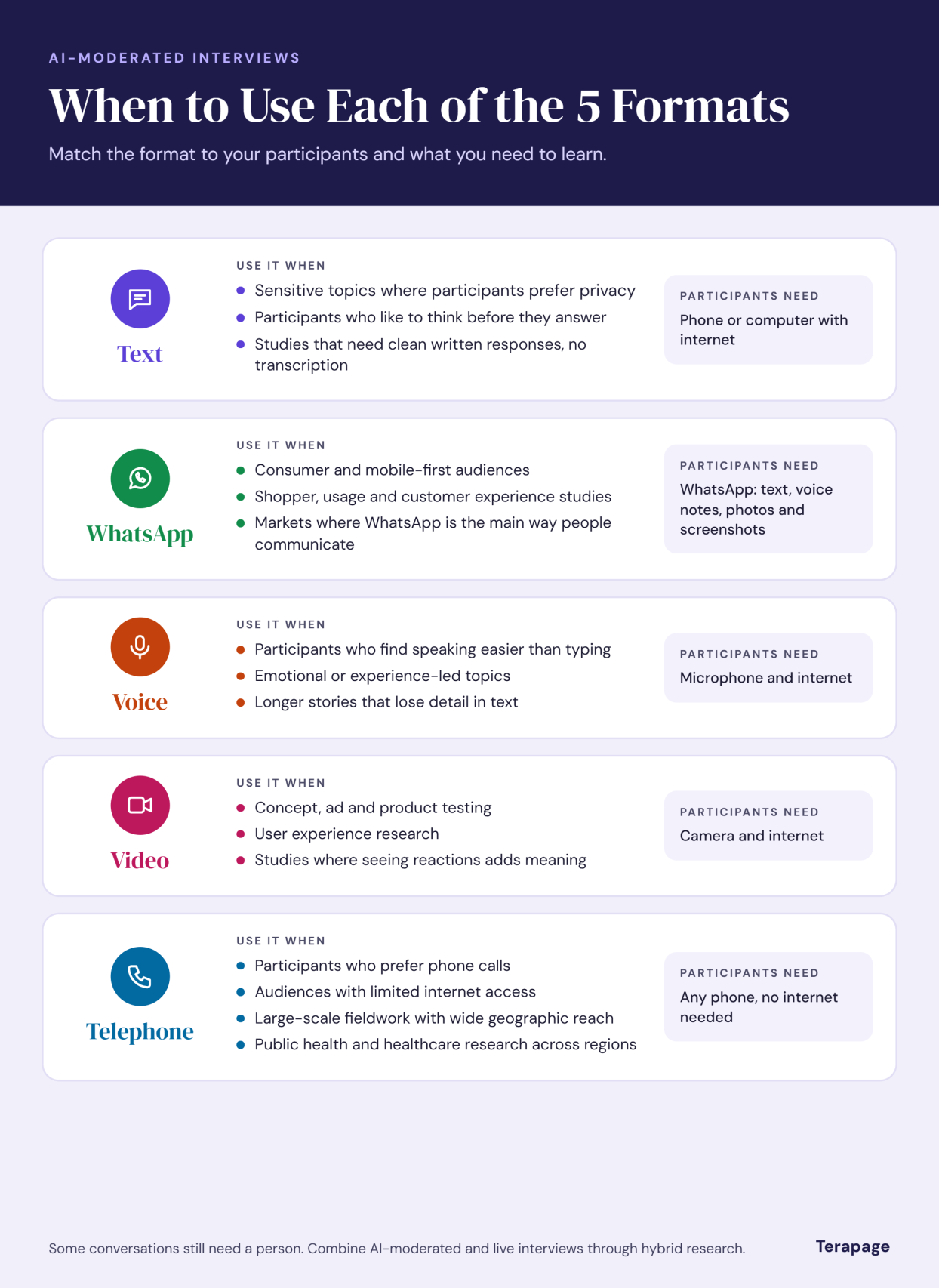
How to Choose the Right AI-Moderated Interview Format
The right format depends on who your participants are and what you need to learn. Use this quick guide to match each format to your study.
Some conversations still need a person, such as very sensitive interviews or stakeholder sessions. For those, many teams combine AI-moderated interviews with live interviews through hybrid research.
How Is Data From AI-Moderated Interviews Analysed?
Analysis does not wait for fieldwork to end. AI-powered insights start working during the conversation and cover every format, so researchers can unlock insights with AI without coding answers by hand.
Transcripts and Speech Maps
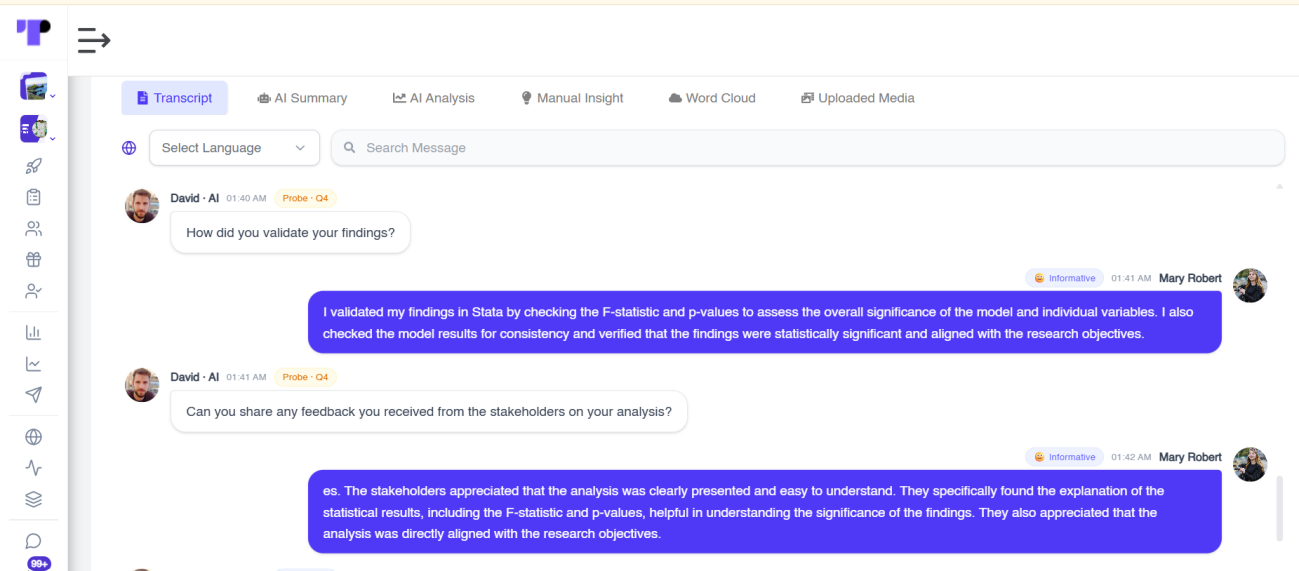
Every interview has a searchable transcript, with an AI summary, AI analysis, word cloud and uploaded media in one place. Each participant answer is tagged, so researchers can quickly spot the most useful moments.
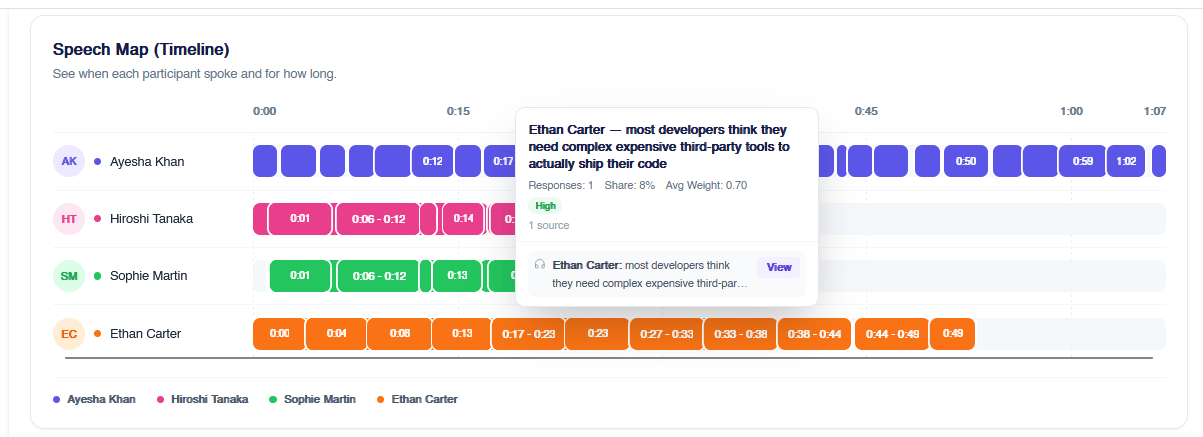
For group and spoken interviews, a speech map shows when each participant spoke and for how long, which helps researchers see who led the conversation.
AI Sentiment Analysis and Intensity
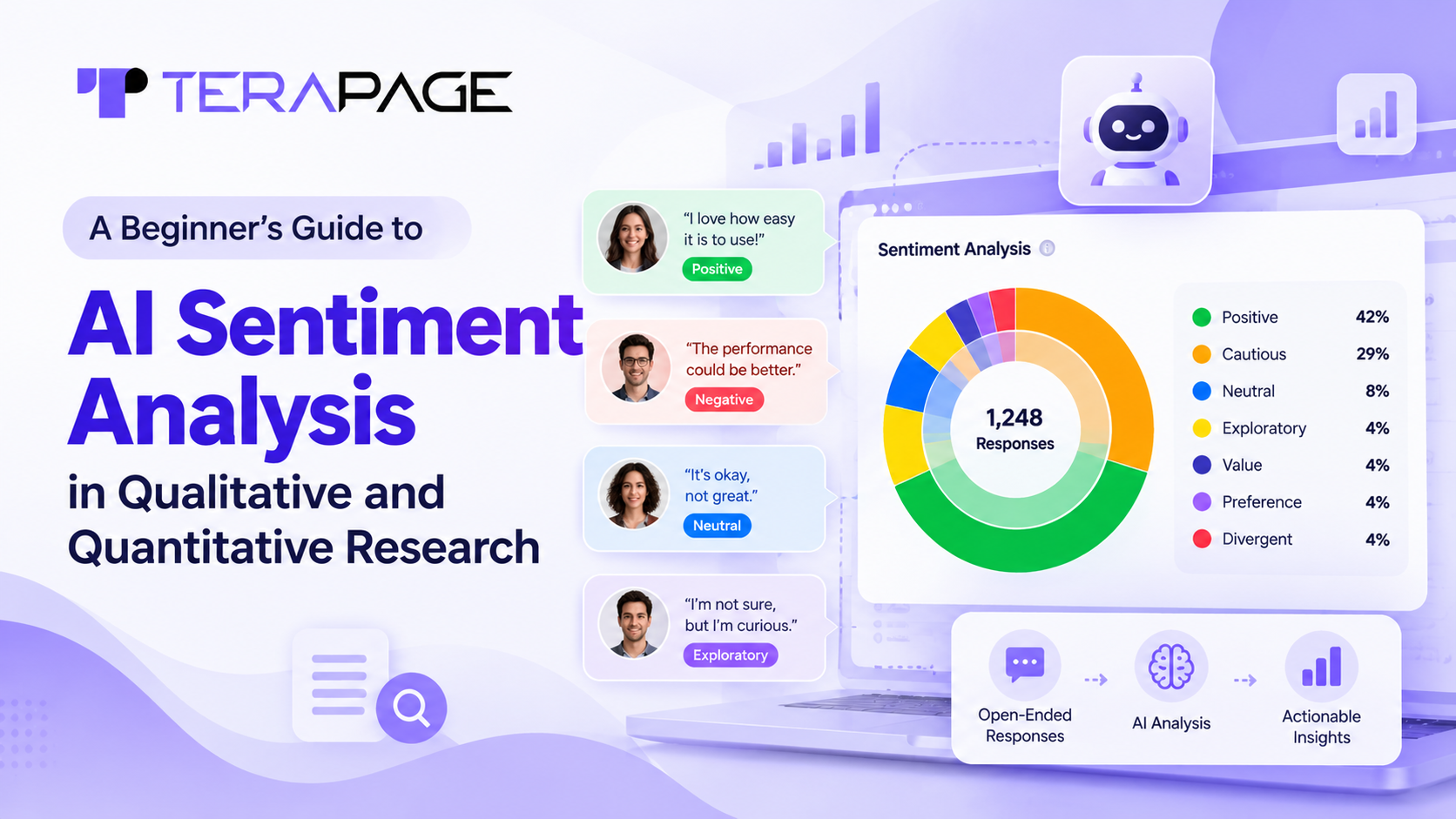
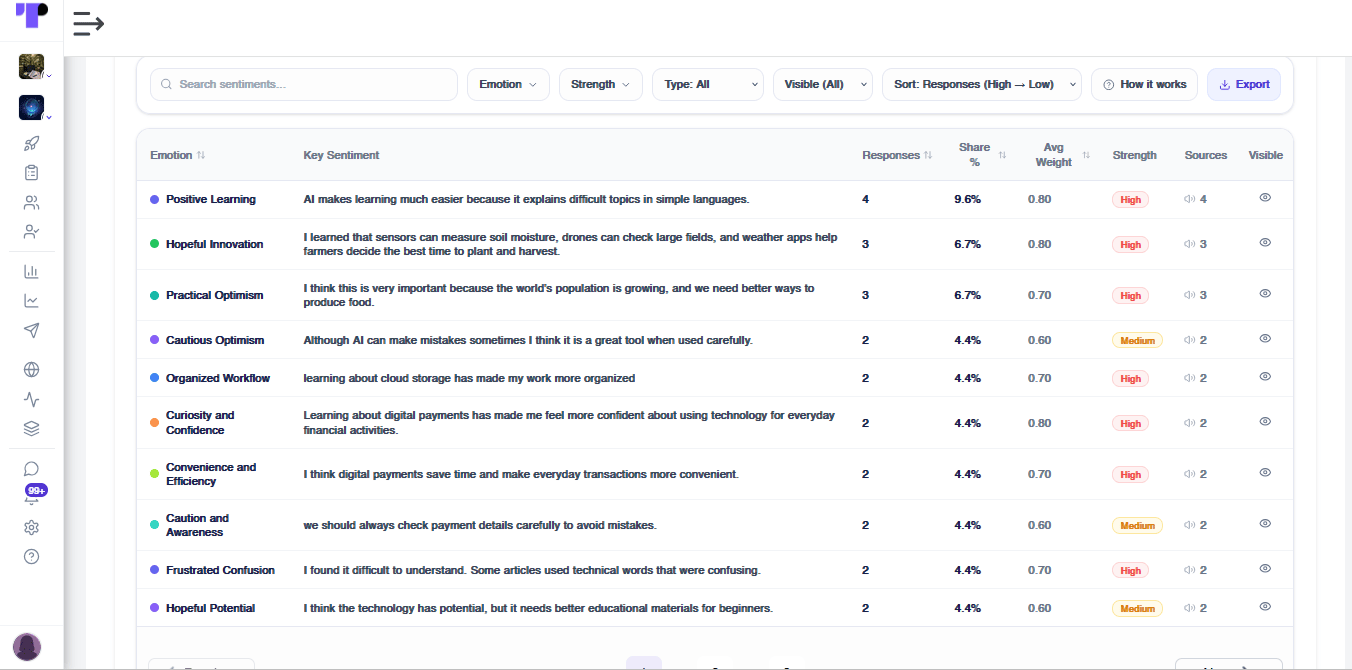
Responses are grouped into mood categories, such as positive learning or cautious optimism, and the granular sentiments behind them. Each mood shows its responses, share, average weight and strength. Learn more in our beginner’s guide to AI sentiment analysis.
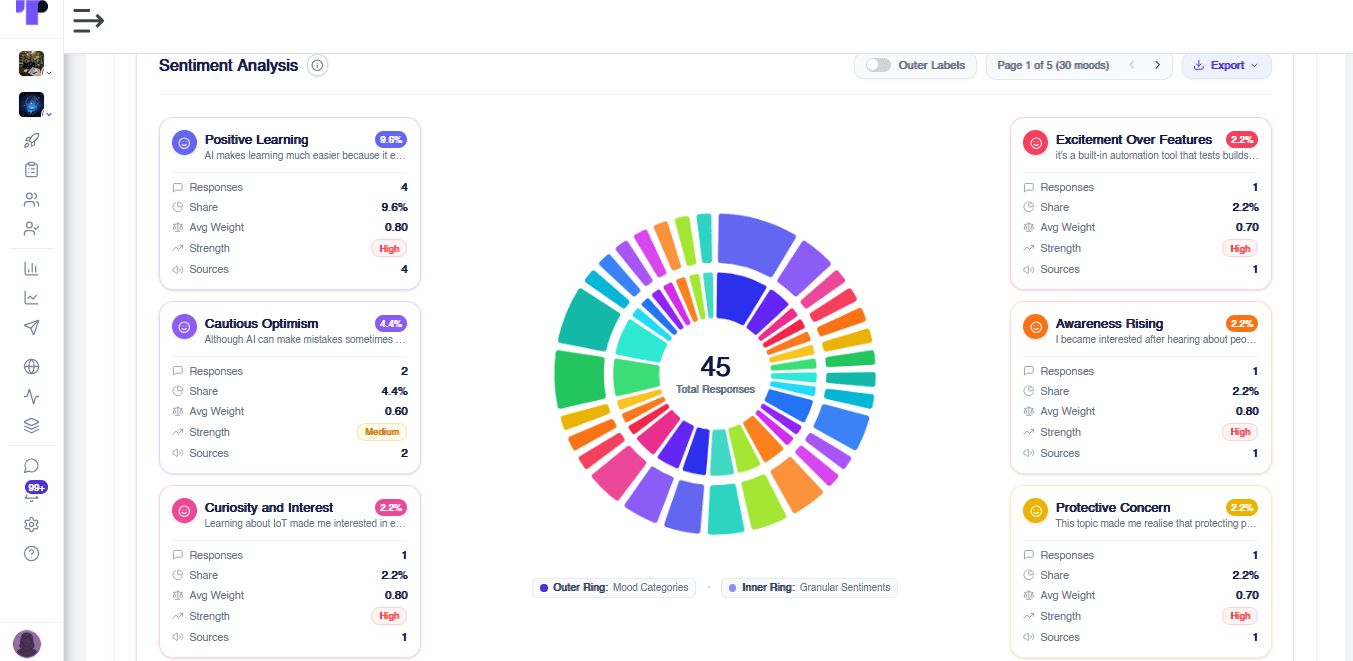
The same results appear in a sentiment table that researchers can filter by emotion and strength, sort and export.
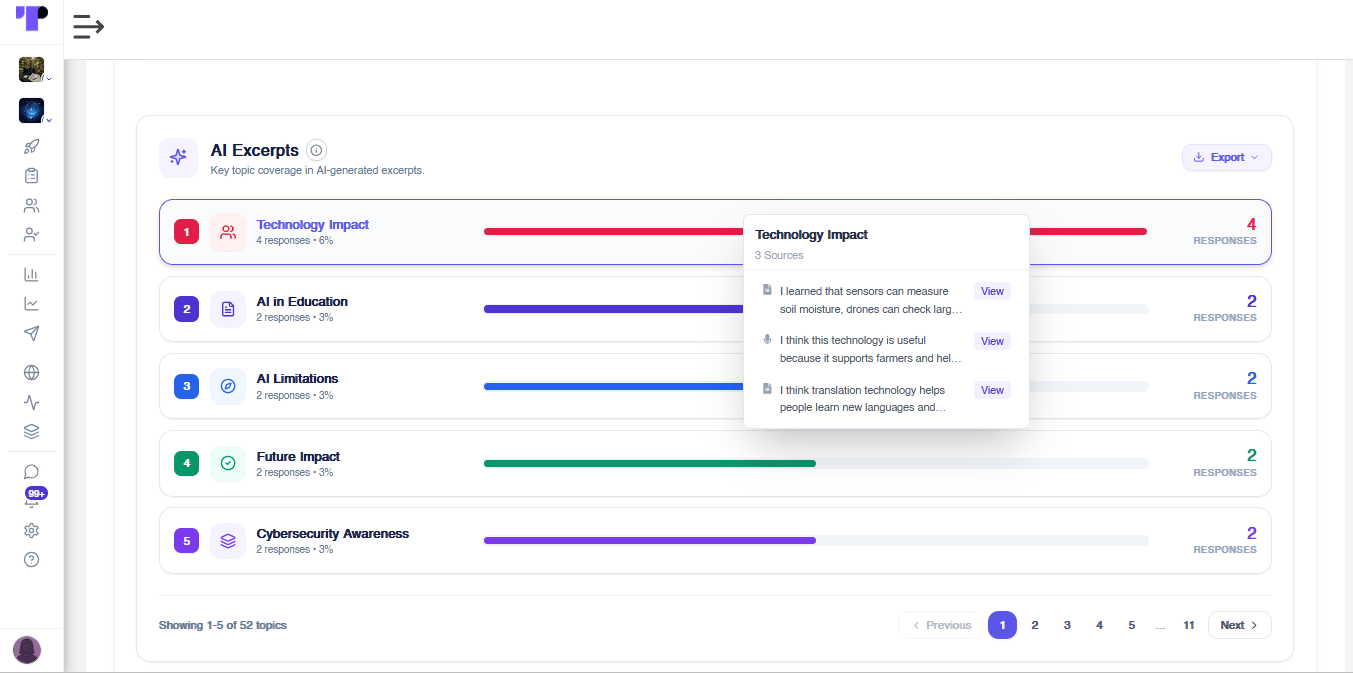
AI Excerpts and Quote Analysis
The AI groups what participants said into topics and ranks them by the number of responses. Hovering over any topic reveals the verbatim quotes behind it.
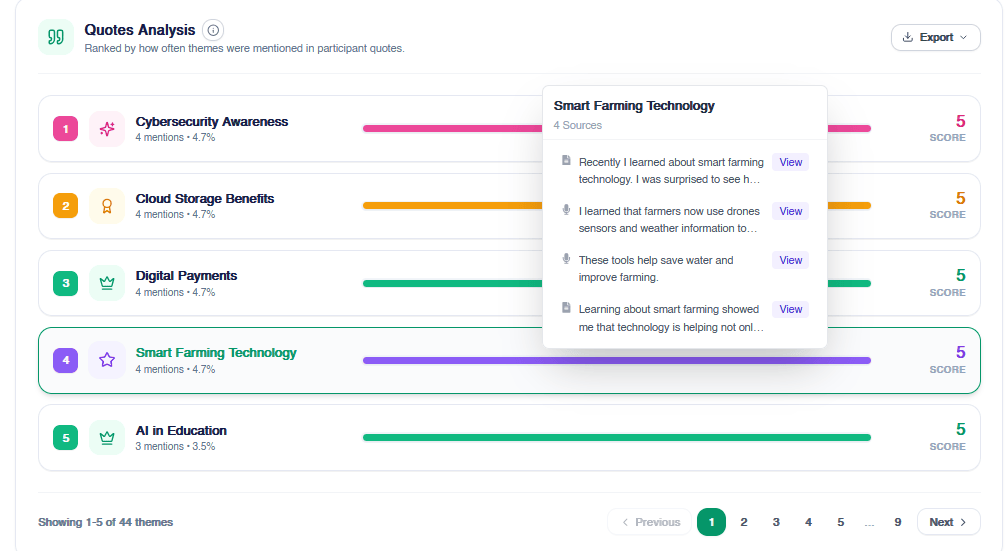
Quote analysis then ranks themes by how often they were mentioned, with every source quote one click away. Findings can move straight into reports and dashboards or branded insight reports.
Consent, Security and AI Transparency in AI-Moderated Interviews
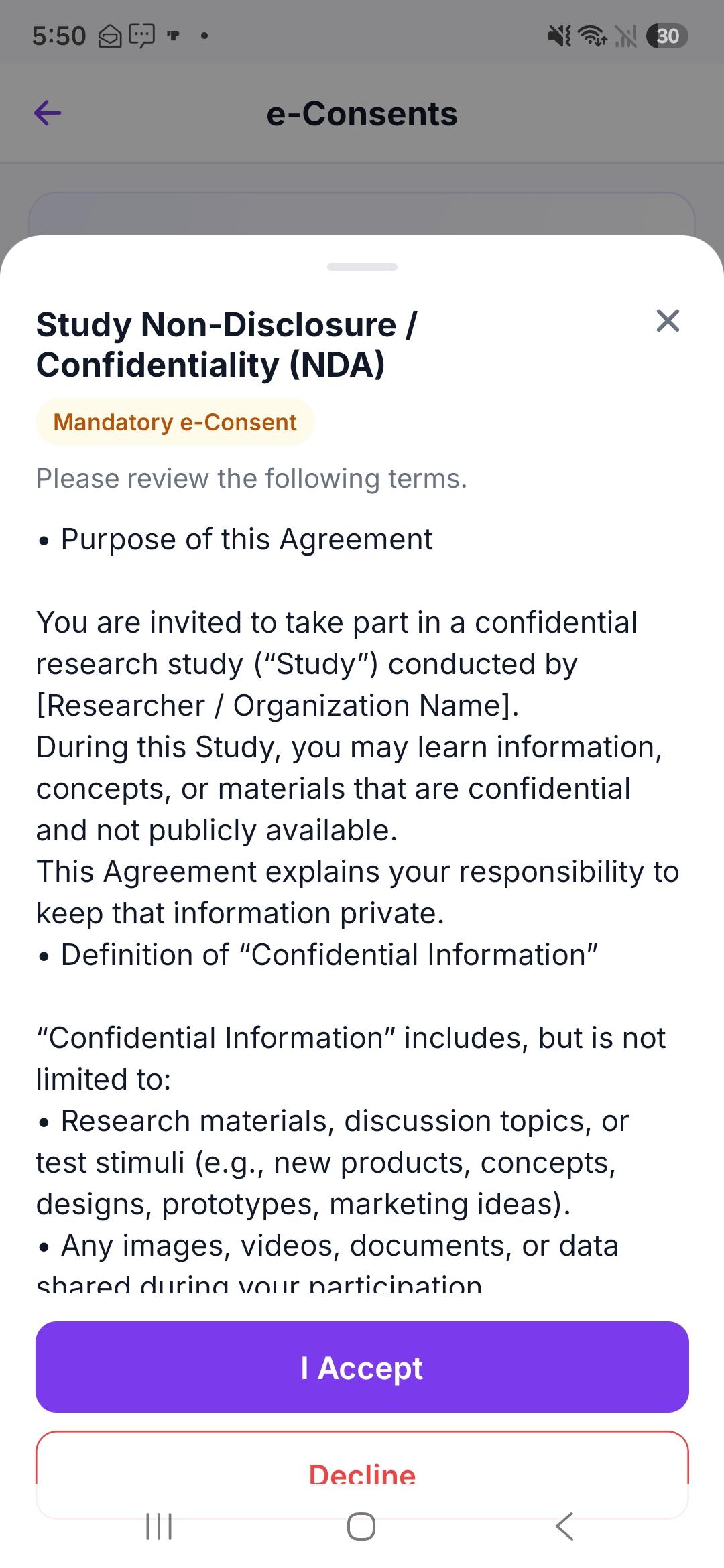
Consent is part of every study set-up. Before an interview begins, participants review and accept the study terms, such as a confidentiality agreement, through a mandatory e-consent. All responses are stored on a secure, GDPR-compliant platform, in line with Terapage’s AI transparency principles.
Choose the AI-Moderated Interview Format That Fits Your Participants
The best AI-moderated interview is the one participants are comfortable taking part in. Text suits considered answers, WhatsApp suits everyday engagement, voice and video capture emotion and reaction, and telephone reaches people that online methods miss. On Terapage, all five formats share one set-up, one AI moderator and one analysis workspace, alongside every other platform feature for in-house teams and research agencies.
To try AI-moderated interviews on your next study, start a free trial or request a demo.
Ready to run AI-moderated interviews in every format?
No credit card required. Need help choosing a format? Our Co-pilot Research Services team can help.